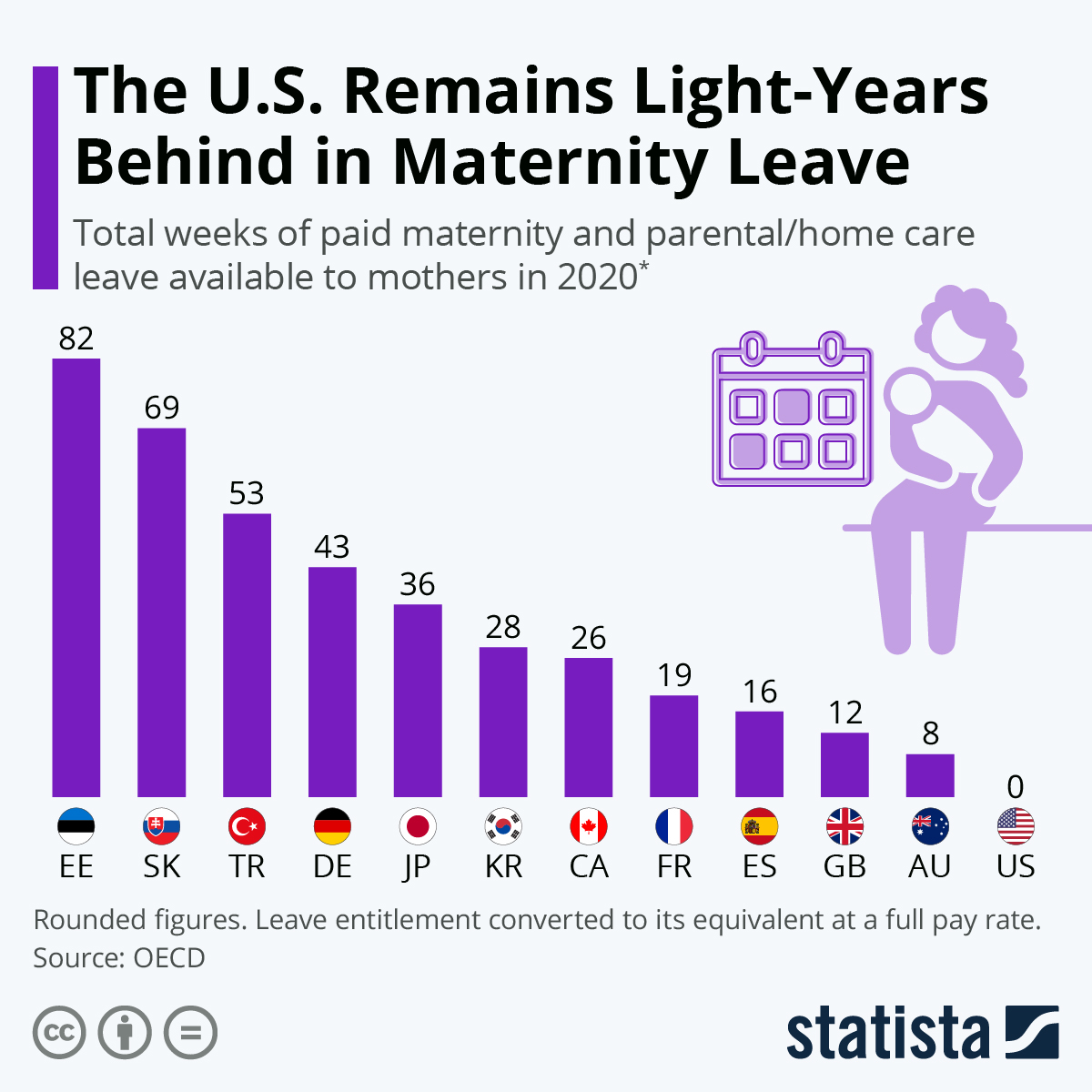
The United States remains one of the few countries in the world that does not guarantee paid maternity leave for employed new mothers at the national level. This stands in stark contrast to many OECD countries, where paid leave around childbirth is widely available. For example, Estonia offers the equivalent of 82 weeks of fully paid leave for mothers, while Hungary provides 76 weeks.
The following chart uses OECD data to compare paid maternity, parental and home-care leave available to mothers across selected countries. To facilitate comparison, leave entitlements have been converted into their full-rate equivalent. For instance, while Czechia offers up to 164 weeks of paid leave, the average benefit replaces just 30.9 percent of previous earnings, resulting in an equivalent of 50.6 weeks at full pay.
Across OECD countries, mothers are entitled to an average of just under 19 weeks of paid maternity leave around childbirth. In several countries, paid leave entitlements extend beyond six months. In nations such as Croatia, Czechia and the United Kingdom, portions of this leave can also be transferred to fathers.
However, benefit levels also vary considerably. In most OECD countries, maternity leave payments replace more than half of a mother's previous earnings. At the lower end of the scale are Ireland and the United Kingdom, where maternity benefits replace less than one-third of average gross earnings.