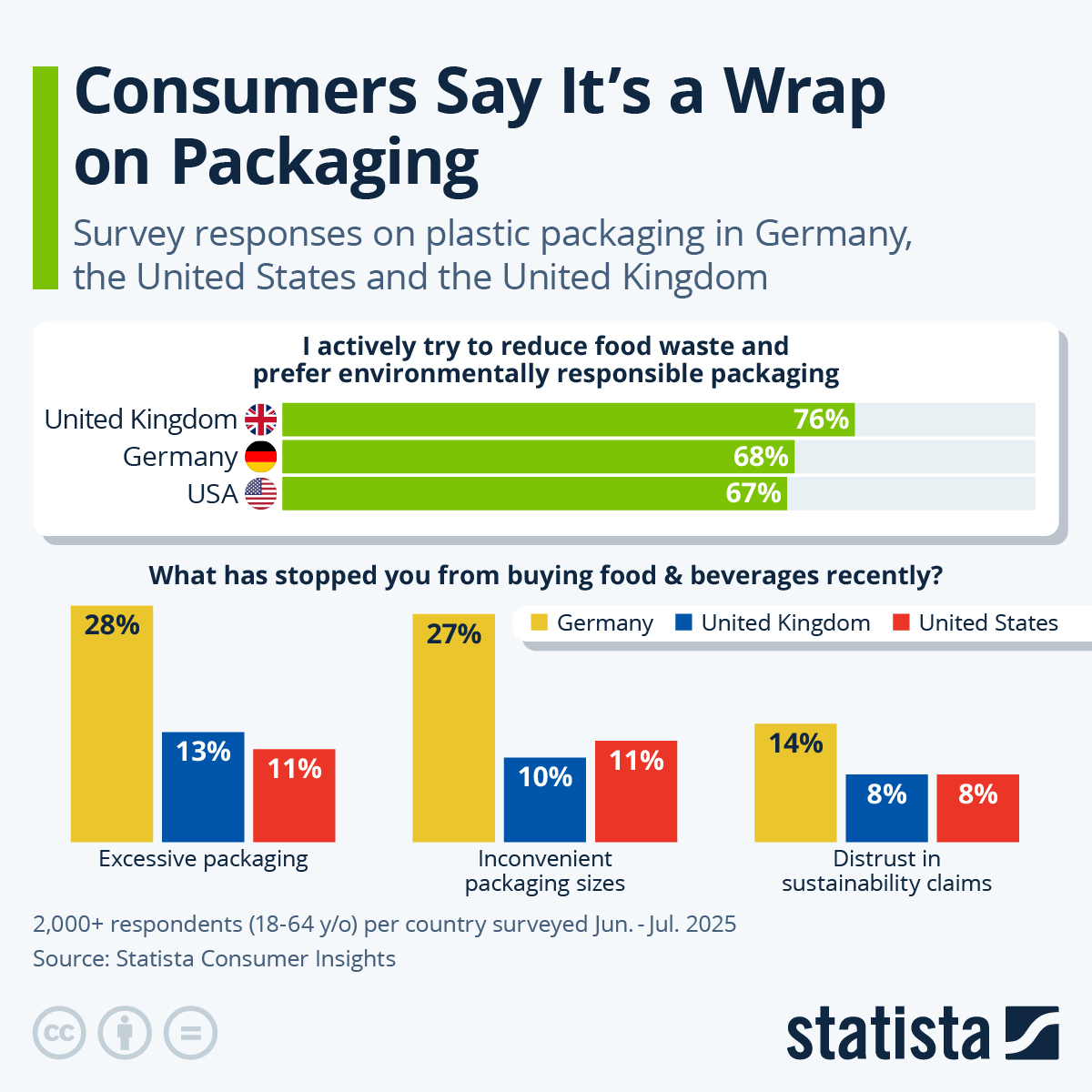
On tomorrow's World Cleanup Day, activists are once again pointing out that a large portion of the plastic waste that ends up in rivers and oceans globally comes from the consumer sector – especially food packaging. But how much does packaging actually influence purchasing behavior? According to a recent survey by Statista Consumer Insights in three countries – Germany, the United Kingdom and the United States – more than two-thirds of respondents said they were actively trying to reduce food waste and that they prefered environmentally friendly packaging. The share was highest in the United Kingdom at 76 percent, followed by Germany (68 percent) and the United States (67 percent).
Despite this attitude, actual shopping behavior might look different. In Germany, 28 percent of respondents stated that they had recently refrained from buying a food item due to excessive packaging. In the two other countries, this share was significantly lower at 13 percent and 11 percent, respectively. Inconvenient packaging sizes are also a greater obstacle for German consumers (27 percent) than for British (10 percent) or U.S. (12 percent) shoppers.
The distrust in sustainability claims is particularly striking: In Germany, 14 percent of respondents expressed doubts about the credibility of such claims – almost twice as many as in the United Kingdom and the United States (8 percent each). The data shows that environmental awareness is present, but not always decisive. While many consumers welcome sustainable packaging, real-life effects on purchasing behavior may differ.
Translated by: Katharina Buchholz
Original by: René Bocksch