Ahead of the 30th UN Climate Change Conference (COP30), which kicks off on November 10 in Brazil, the United Nations has published the sixteenth edition of its Emissions Gap Report. The organization highlights that global "reductions to annual emissions of 35 and 55 percent, compared with 2019 levels, are needed in 2035 to align with the Paris Agreement 2°C and 1.5°C pathways, respectively", and that "given the size of the cuts needed, the short time available to deliver them and a challenging political climate, a higher exceedance of 1.5°C will happen, very likely within the next decade. "
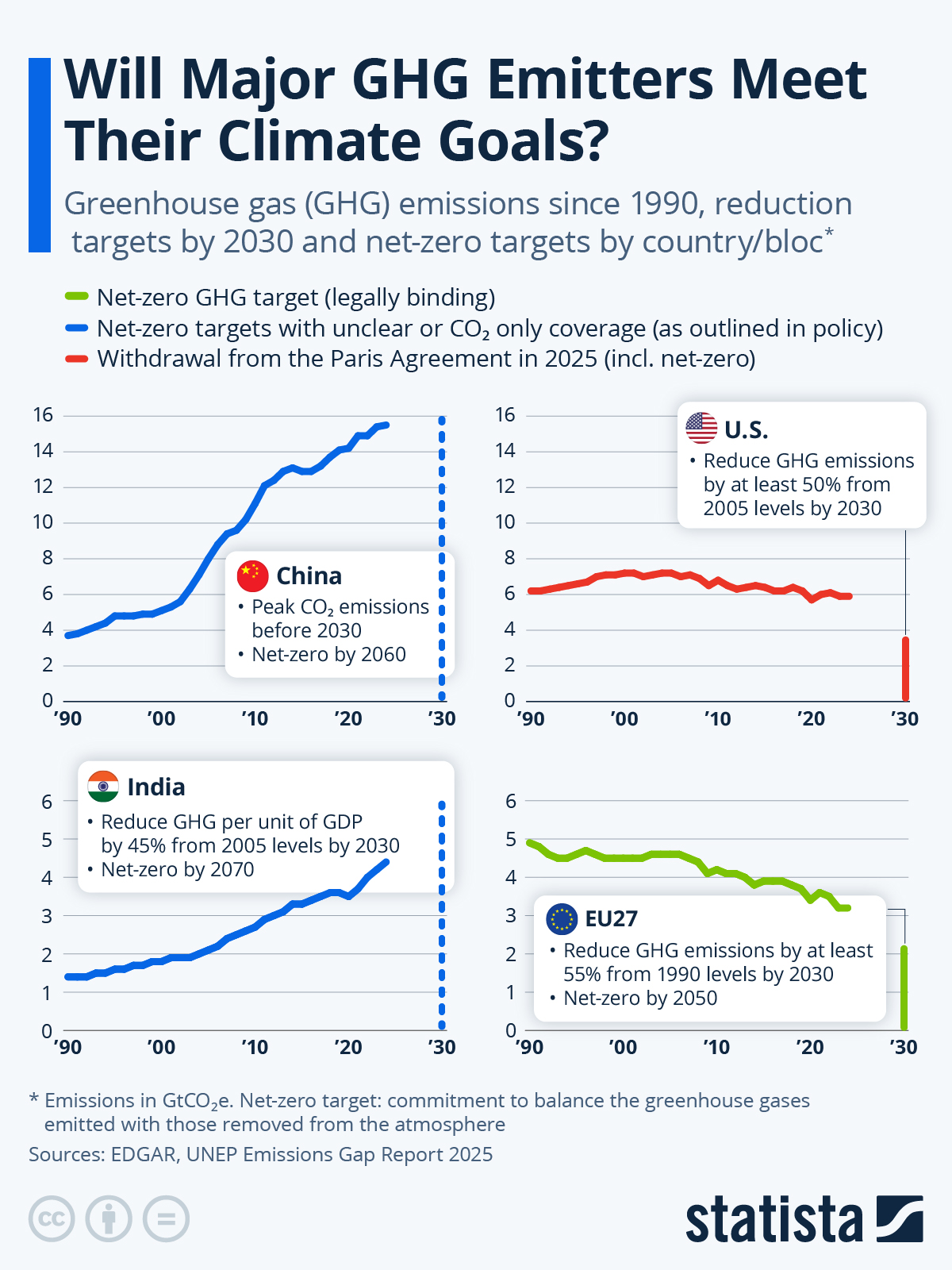
Based on data provided by EDGAR and the Emissions Gap Report 2025, our infographic provides an overview of the change in greenhouse gas (GHG) emissions from major emitters since 1990 and their reduction targets/commitments for 2030 and beyond. The world's four largest emitters - China, the United States, the European Union and India - account for over 60 percent of global GHG emissions. This means that their climate commitments for 2030 and net-zero targets (i.e. pledges to balance the GHGs emitted with those removed from the atmosphere) will shape the planet's ability to limit global warming.
The first one, China, has seen its GHG emissions triple since the early 2000s. Its main goal is to reach its peak carbon emissions before 2030, while it is aiming for 2060 for its net-zero target. The second one, the United States, saw its emissions peak in the early 2000s and targets to reduce GHG emissions by 50-52 percent below 2005 levels by 2030. However, the United States withdrew from the Paris Agreement in January 2025, including its national net-zero target. For its part, India surpassed the European Union in terms of emissions in 2020 (33 percent growth over ten years). While seeking to reconcile its economic development and energy access with its climate goals, India's main goal for 2030 is to reduce GHG emissions per unit of GDP by 45 percent from 2005 levels, while its net-zero target is set for 2070. As our infographic shows, the European Union is the only one of the four major emitters to have set a legally binding net-zero GHG target by 2050. In addition, the bloc aims to reduce GHG emissions by at least 55 percent by 2030 from its peak level in 1990.