In November 2015, a string of attacks later claimed by terror group ISIS in the French capital Paris killed 137 people and shook the world. Ten years on, jihadist terror in Europe is still a major topic of concern, data by Europol shows. At the same time, ISIS in Syria and Iraq has had its presence majorly decimated, leading to fewer attacks and victims by the terror group in the region and elsewhere, while ISIS subgroups in African countries are inflicting more deadly attacks, mostly on their strongholds in the Sahel region, West Africa and the Democratic Republic of the Congo.
ISIS remains a threat even in its original location but has lost territory and influence as is was pushed back by local troops and an international alliance. This caused the group to change its strategy and pivot to a decentralized model of subgroups scattered across the globe, operating in near-autonomy. Especially in Africa, the terror group has been able to exploit the local realities of what the Geopolitical Monitor calls "chronic fragilty".
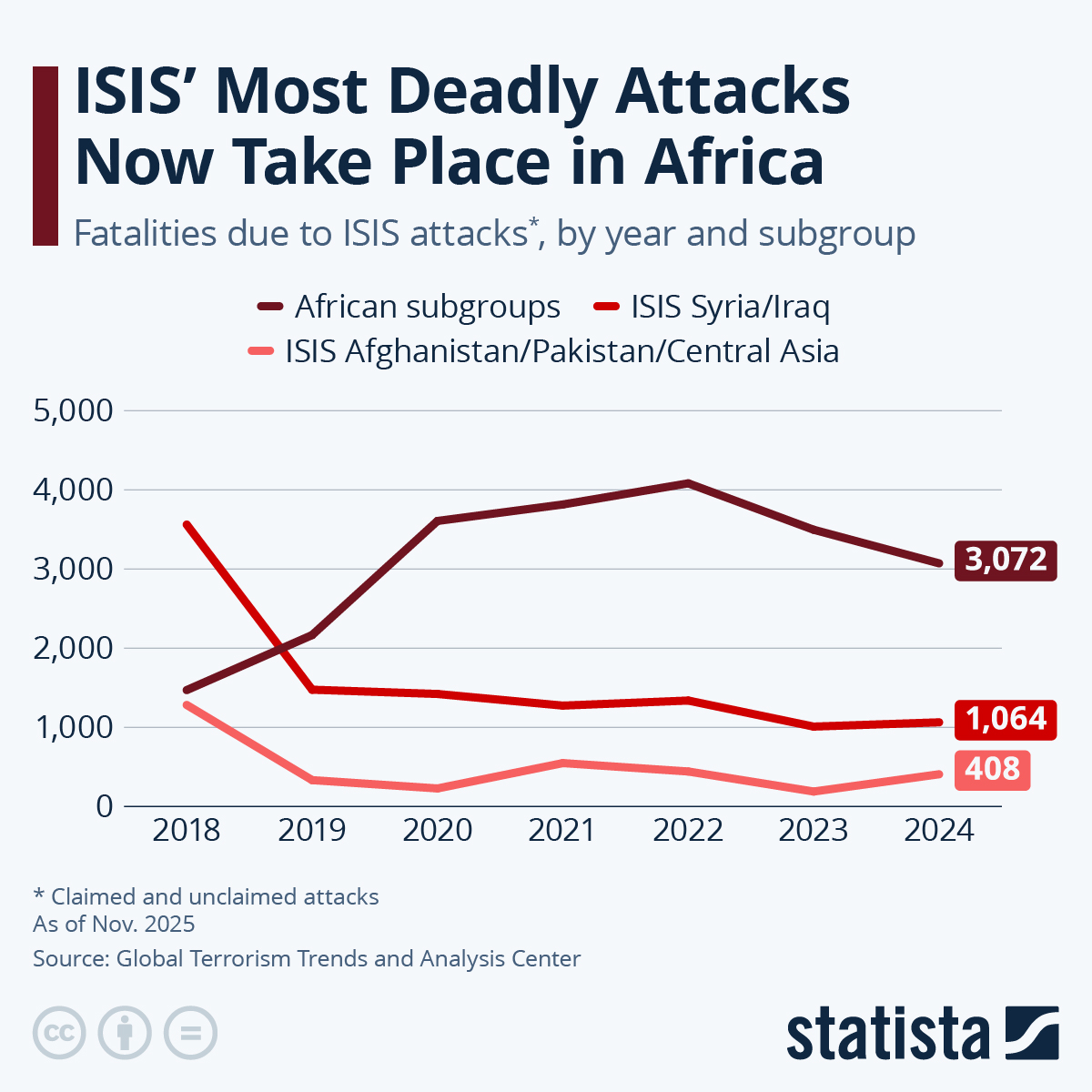
Data by the Global Terrorism Trends and Analysis Center accessed in November 2025 shows that the ISIS subgroups Greater Sahara, Western Africa, DRC, Somalia and Mozambique claimed the lives of more than 3,000 people last year. This is a stark increase from just around 600 in 2018. Northern African groups were less active in 2024, but had killed as many 800 in 2018.
At the same time, ISIS core groups in Syria and Iraq were still responsible for the deaths of around 1,000 people last year, down from 3,500 in 2018. ISIS in the Khorasan region, encompassing Afghanistan, Pakistan, Iran and Central Asia was also decimated over the years and killed fewer than 400 recently, down from more than 1,200 when database records started in 2018.