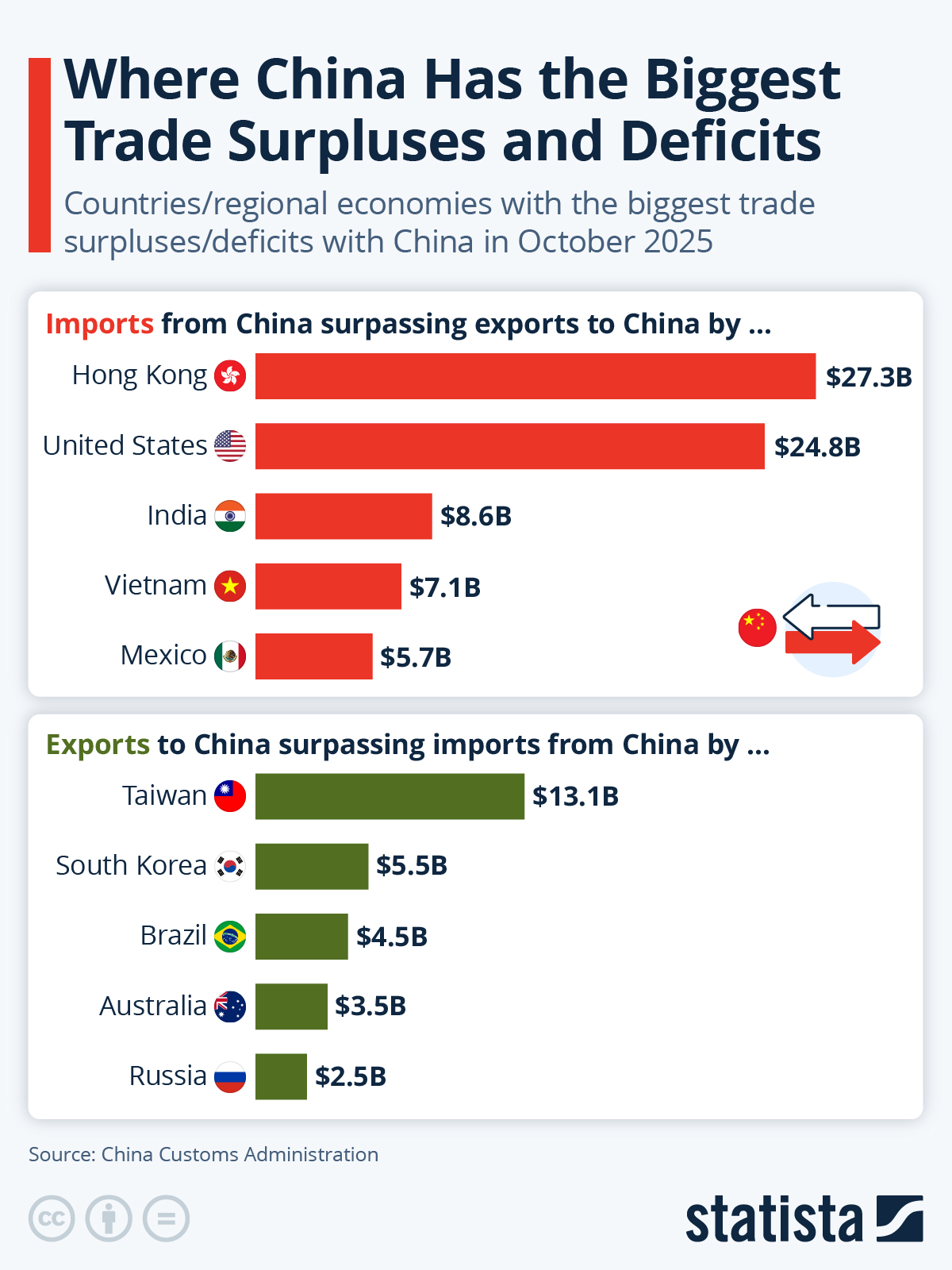
The United States traditionally has had one of the biggest trade deficits with China in the world and it remains in this position in October 2025 even after a massive overhaul of the U.S. tariff system under the Trump administration. This is according to China's Customs Administration. Despite Chinese imports to the U.S. decreasing, the Chinese trade surplus with the U.S. still stood at almost $25 billion a month, only surpassed by China's close neighbor Hong Kong at around $27 billion. Other countries running large deficits with China include India, Vietnam and Mexico. While the U.S. has decreased its dependence on China slightly, this means that other countries have been buying more from China as the country has aggressively marketed its goods in order to keep up export volume.
On the other side of the spectrum are Taiwan and South Korea, which sell more to China than they buy from it, at least in monetary terms. This is due to the countries' high-tech industries. Brazil also sold goods worth $4.7 billion more to China than it bought from the country – in large parts caused by its florishing export of soybeans. Australia and Russia, which round out the top 5 of trade surpluses with China, also sell raw materials and fossil fuels to the country.
Countries with the largest relative trade deficits with China included Egypt (trade deficit with China at 92 percent of overall bilateral trade), Greece (86 percent), Poland (80 percent), Turkey (79 percent) and Nigeria (79 percent). Meanwhile, the Swiss trade surplus with China made up 69 percent of the two countries' overall trade, compared to 63 percent in Ireland, 58 percent in Mongolia and 41 percent in Bolivia.
A look at the nations running the biggest trade surpluses and deficits overall shows how important Chinese trade is for the world economy. Here, the United States once again ranks among the biggest deficits, followed by another big Chinese buyer, India, in rank 3. For the countries with the strongest export trades, China tops the list, followed by Russia. Despite its strong exports to China, Brazil remains a net buyer in the world economy, however.