In a year marked by intensifying geopolitical tensions, rising living costs and mounting pressure on public institutions, Transparency International's Corruption Perceptions Index 2025 paints a bleak, yet familiar picture: corruption remains rampant and, while progress is uneven and fragile, recent slippage among some democracies (U.S., Sweden, France, etc.) shows corruption risks can rise even where institutions once looked secure. As the organization points out, in almost two-thirds of countries that have seen their scores deteriorate significantly since 2012, "there has been a worrying pattern of restriction on freedoms of expression, association and assembly". Transparency International lists several examples of "politicised interference with operations of NGOs", taking the form of restrictive laws "often paired with smear campaigns and intimidation". Put simply, where democracy is weakened, corruption risks appear harder to contain.
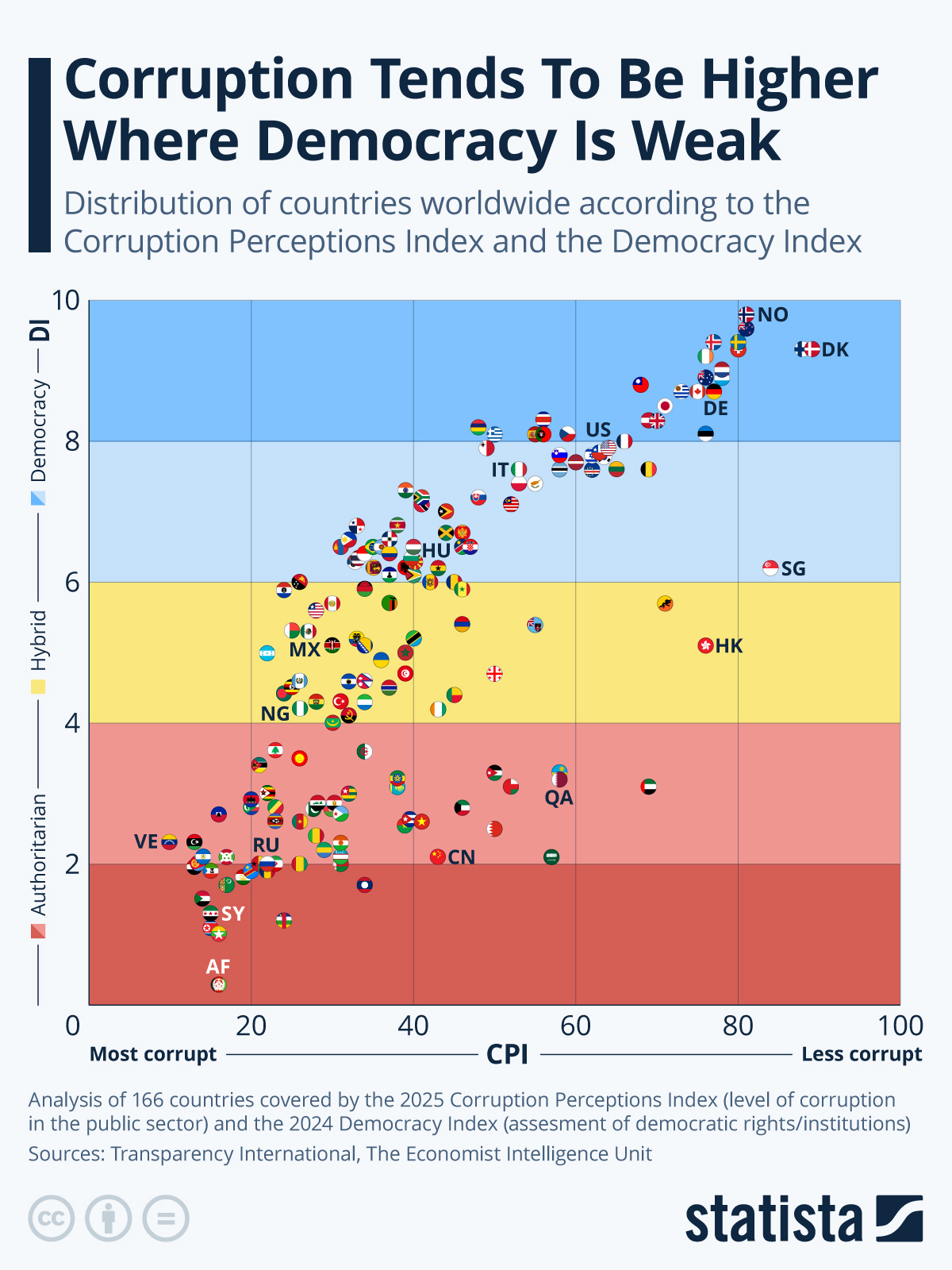
As highlighted by the infographic below, plotting Corruption Perceptions Index 2025 scores (0 to 100, higher = “cleaner" public sector) against Democracy Index 2024 scores (0 to 10, higher = "more democratic") reveals a strong pattern. Countries that score high on democracy generally also rank among the least corrupt, while low-democracy countries cluster toward the more corrupt end of the CPI. Across the 166 countries in the dataset, the relationship is pronounced (Pearson correlation coefficient = 0.77, much closer to 1 than to -1), indicating a strong correlation between higher perceived levels of corruption in the public sector and poorer democratic institutions and rights.
At the top-right of the chart ("best" CPI and democracy index), sit many of the usual suspects: Denmark, Finland, Norway and New Zealand record among the highest integrity scores (CPI over 80), all with democracy scores above 9. Moving left and down, the cloud of dots thickens: many countries with hybrid or authoritarian governance models tend to record weaker CPI results. At the bottom, the fifteen most corrupt countries (CPI scores: 10-19) all have a democracy index below 3 (worst authoritarian regimes). In practical terms, this pattern reflects the importance of institutional mechanisms that generally help combat corruption: independent courts, investigative journalism, free/regular elections and effective accountability mechanisms, which are generally very limited in autocracies or war-torn countries.
That said, the graph also highlights that some countries deviate from the general trend: Singapore, for instance, combines a strong CPI score (84) with a democracy index in the mid-range (around 6), showing that perceptions of public sector integrity can be relatively high even in certain states that score lower on pluralism and civil liberties. Conversely, there are cases where democratic institutions and rights are considered relatively strong, but where perceptions of corruption remain stubborn, for example in Greece or Spain (democracy scores around 8; CPI: 50-55).