According to a report published last year by UNICEF, India is witnessing a rapid rise of overweight and obesity across all age groups, including among young children and teenagers. Countries in South Asia had the lowest prevalence of overweight in 2000, but by 2022, the prevalence had increased almost fivefold among children aged 5–9 years, 10–14 years, and 15–19 years.
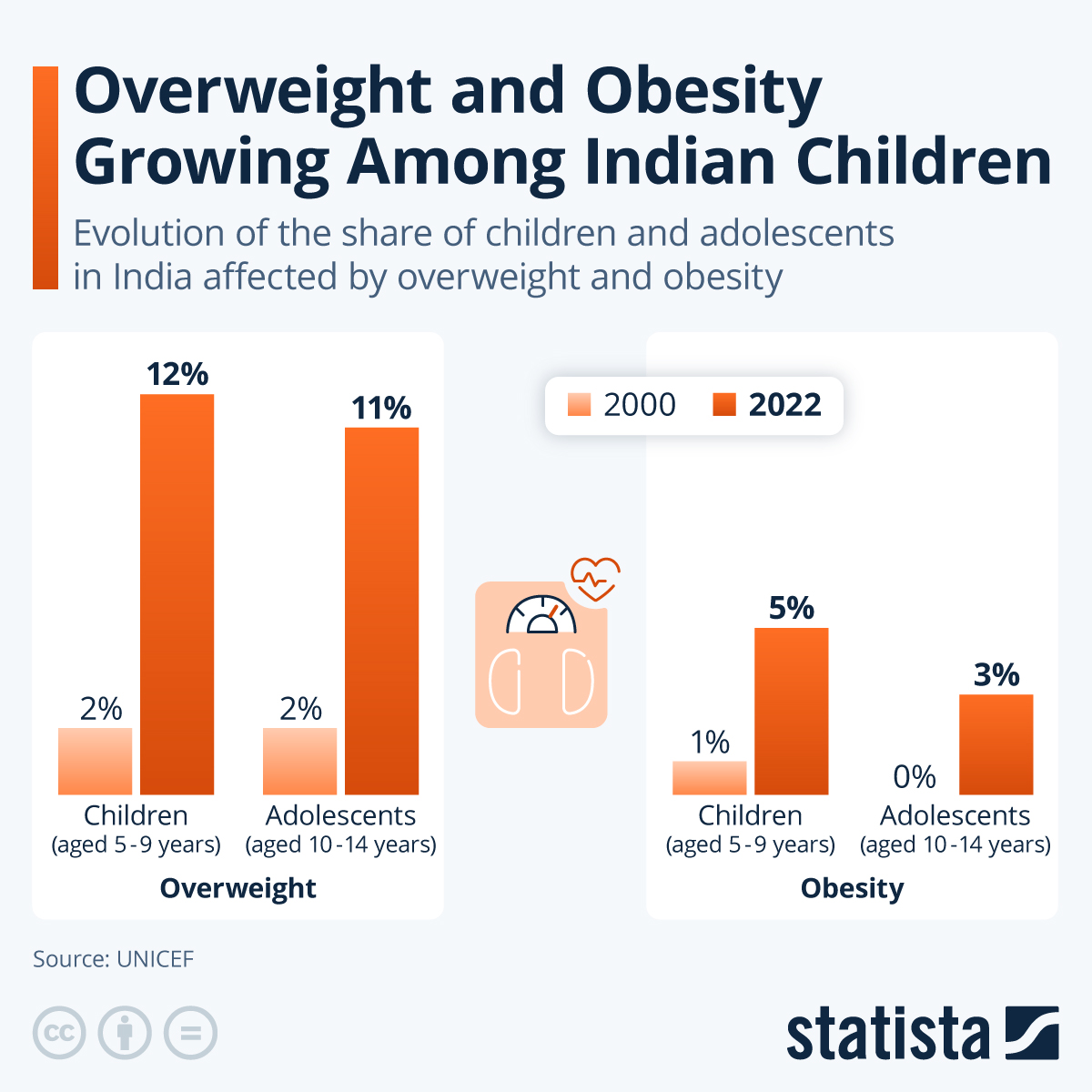
As our infographic shows, only two percent of children and adolescents aged 5 to 14 were considered overweight in 2000 (UNICEF defines overweight for these age groups as having a BMI-for-age over one point above the median according to WHO guidelines). In 2022, 12 percent of children aged 5 to 9 and 11 percent of adolescents aged 10 to 14 were considered overweight in the country. While rates of obesity (BMI-for-age over two points above the median) remain lower, their increase is also worrying: in 2000, zero percent of teenagers aged 10 to 14 were considered obese, while they represented 3 percent of the age group in 2022.
UNICEF predicts that India will be home to over 27 million children and adolescents (5 to 19 years) living with obesity by 2030, and will account for 11 percent of the global burden. One of the reasons highlighted by the organisation for the rise of overweight and obesity in India is the surge in consumption of ultra-processed food, which jumped from $900 million in 2006 to $37.9 billion in 2019. According to UNICEF, obesity has, for the first time, surpassed underweight globally as the most common form of malnutrition among school-aged children and adolescents. Today, one in ten children worldwide, nearly 188 million, live with obesity.