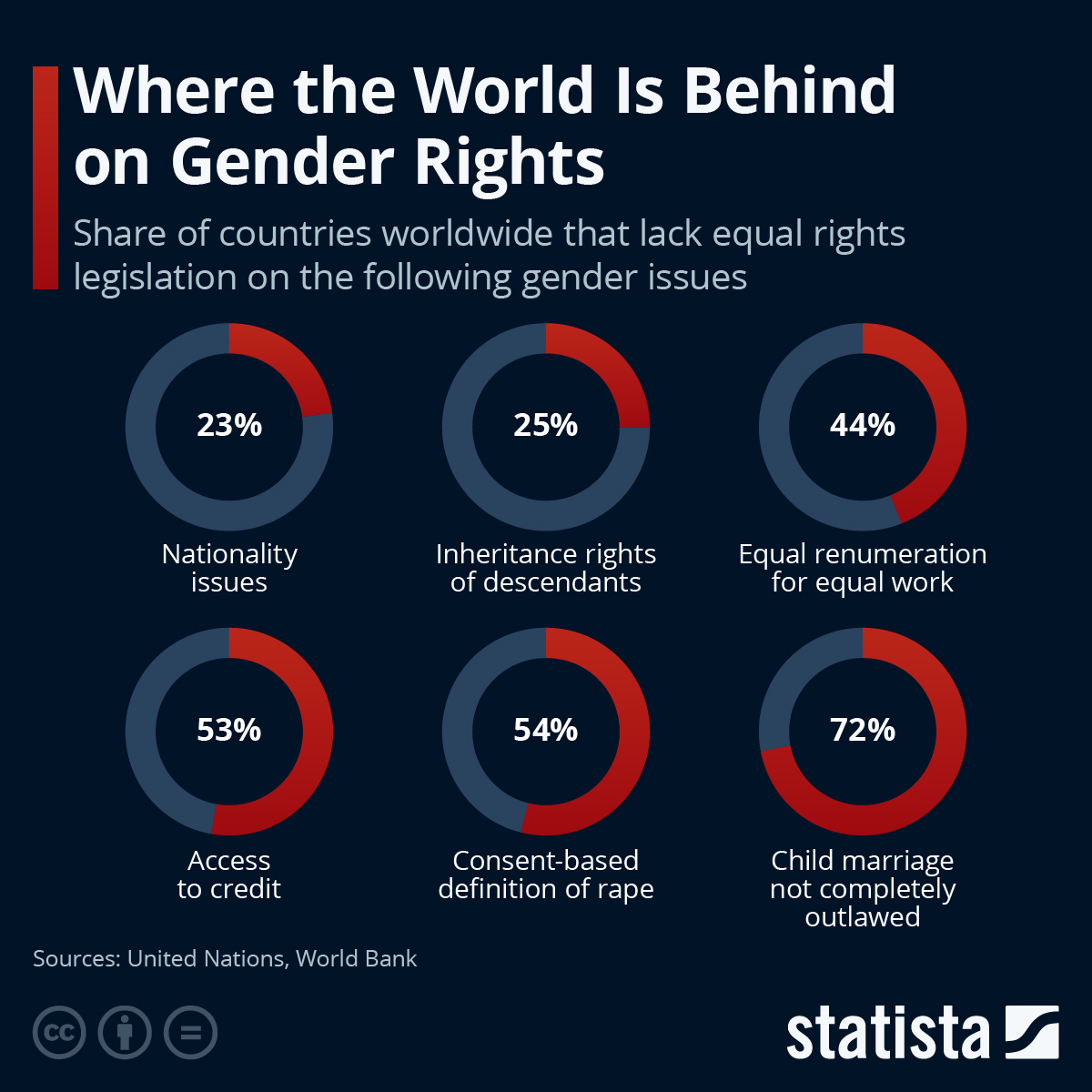
On the 115th International Women's Day observed this Saturday, much of the world is still very much behind on providing legal frameworks and access to justice for women and girls. According to an official release by the United Nations Commission on the Status of Women and data by the World Bank, women still face greater barriers to justice in nearly 70 percent of countries globally.
More specifically, the data shows that in more than half of countries, women don't have equal access to credit and roughly the same share of nations has not introduced consent-based definitions of rape, a major hurdle for women bring cases before a court. An even higher number of countries, almost three quarters, have not completely outlawed child marriage – an issue that affects girls disproportionately.
A still high 44 percent of nations does not guarantee equal pay for equal work. This affects women not only in their ability to advocate to be paid fair wages, but also limits their economic freedom, career opportunities and say in family dynamics.
Some more seemingly antiquated issues are still found in a surprisingly high number of countries. At least 45 nations or a total of 23 percent don't treat men and women the same when it comes to questions of nationality. Discriminatory laws include those that pass on the father's nationality to a child in case the parents' nationalities differ or allow a man to pass their nationality on to their wife but not vice versa. A similar share of nations, 25 percent, do not guarantee sons and daughters the same rights to inheritance. The share not granting the same inheritance rights to surviving male and female spouses is just a little lower. These countries are predominantly found in Northern Africa, Asia and the Middle East, according to the World Bank.
Just a few countries still haven't achieved equal rights in financial issues like opening a bank account individually, owning property and sharing assets during marriage. These gaps exist today in Niger, Chad, Cameroon, Guinea-Bissau and Equatorial Guinea as well as in Mauritania, South Sudan, the Republic of the Congo, the Democratic Republic of the Congo, the Philippines and Chile (latter two issues only).