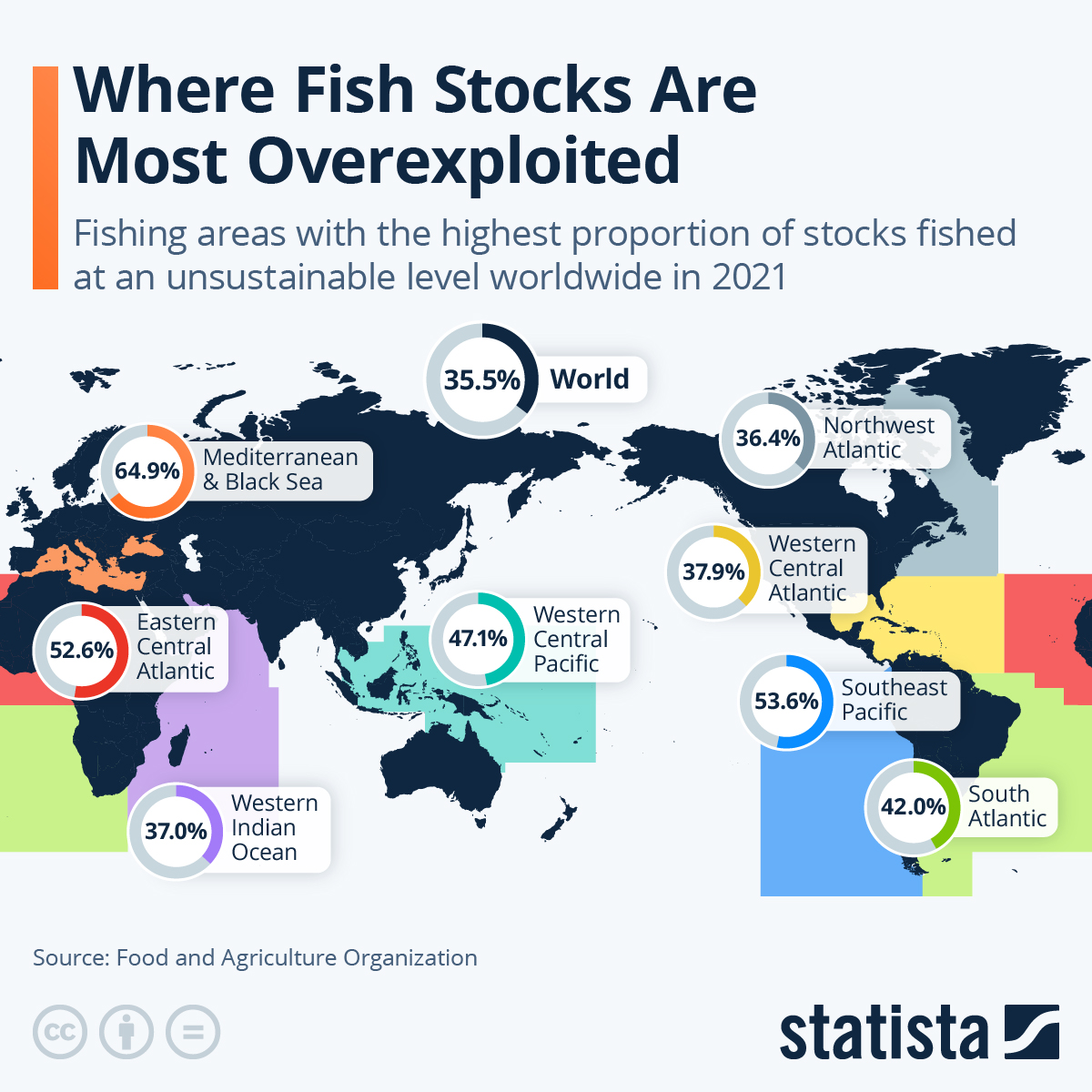
Fishing stocks in many parts of the world are heavily affected by overfishing, figures by the FAO show. The reasons for this include illegal fishing, which is most prevalent in the Western Central Pacific around the South China Sea as well as in the Eastern Central Atlantic close to West Africa.
But the data also shows that large-scale industrial fleets and a big demand for fish are on their own already major factors in decimating fishing stocks. This is the case in the Mediterranean and the Black Sea as well as the Southeast Pacific off the coast of South America. Illegal fishing also plays a part here, but is less widespread.
The FAO in its latest fisheries report writes that the share of unsustainably fished stocks worldwide increased to 37.7 percent (unweighted) in 2021, up from 35.4 percent in 2019 and 10 percent in 1974. This is despite the fact that UN developmental goals are currently aiming to decrease overfishing and that its prevalence will eventually hurt those currently earning money off fisheries. Weighted for prevalence of type of fish and catch, the latest share of global overfished stocks was 23.1 percent.
All the aforementioned regions are seeing around 50 percent to 65 percent of their fishing stocks extracted at unsustainable levels. They are followed by the Southern Atlantic, the Northwest and Western Central Atlantic around the Canadian Coast and the Caribbean, respectively, as well as the Western Indian Ocean. In these locales, around 40 percent of stocks are fished at an unsustainable level.