At least four ships have been hijacked off the coast of Somalia in recent weeks, stoking fears of a piracy resurgence in the region. Officials say the rise in attacks is connected to the war in Iran, as pirates are taking the opportunity to act while naval forces are preoccupied with the blockade of the Strait of Hormuz. The EU’s Maritime Security Centre Indian Ocean has called for all vessels in the area to maintain “heightened vigilance”, especially between Mogadishu and Hafun.
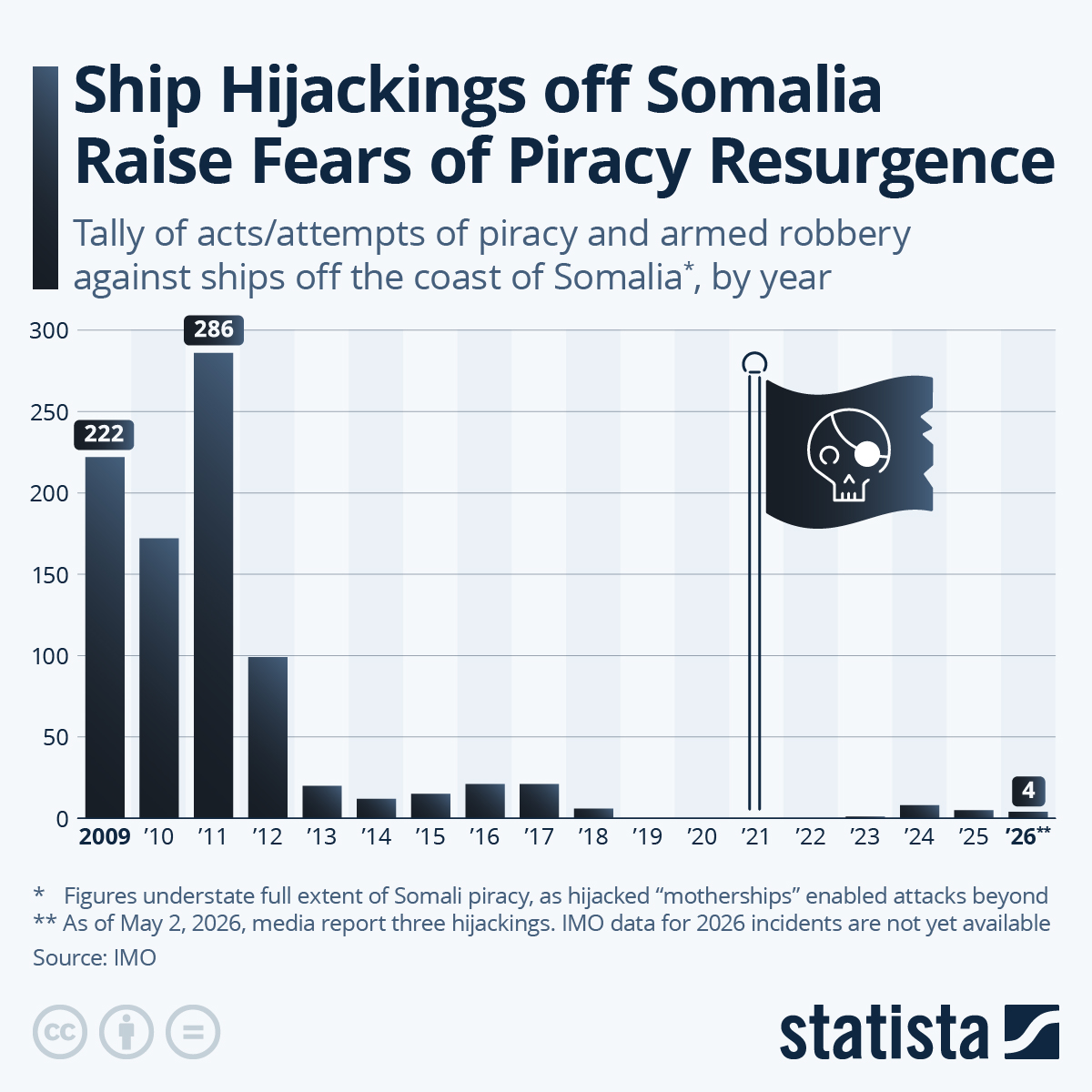
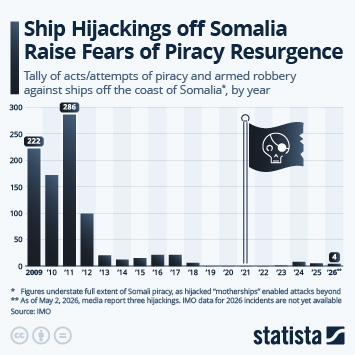
Somalia has a decades-long history of piracy. Attacks off the country's coast reached their peak in 2011, when the International Maritime Organization recorded 286 incidents, including both attempted and successful attacks. A coordinated international response, including naval patrols and onboard security, then drove a steep decline, with cases falling to 99 in 2012 and just 12 by 2015. For three consecutive years between 2020 and 2022, no incidents were reported to the IMO in this area at all.
But these figures only tell part of the story. In 2009, most piracy cases were concentrated off East Africa, where 222 incidents, including 48 hijackings, were recorded. By 2010, however, Somali pirates had started to use captured dhows, fishing vessels and merchant ships as “motherships” in order to extend their operational reach. As a result, incidents off East Africa fell to 172, while attacks in the Indian Ocean rose from 27 to 77 (including a rise from two hijackings to 20). Activity in the Arabian Sea also increased over the same period, from two to 16.
Even as overall incidents of Somalia-based piracy dropped in 2012 (from 286 to 99), pirates became marginally more efficient. In 2011, 33 of 286 attacks resulted in hijackings (an 11.5 percent success rate). A year later, 13 of 99 attacks led to hijackings, pushing the success rate slightly higher to just over 13 percent, with many cases involving smaller vessels such as dhows and fishing boats.
By 2014, incidents linked to Somalia-based pirates had fallen to 12, well below the 78 recorded in 2007, when the phenomenon was prevalent. Still, the threat had not fully disappeared. Activity ticked up again in the Arabian Sea in 2016 and 2017, with four vessels successfully boarded and hijacked in the latter year by Somalia pirates.
After a period of relative calm, piracy re-emerged in the region in late 2023. Analysts attribute this uptick to the diversion of naval patrols to the Red Sea following Houthi attacks on vessels in the Bab al-Mandeb Strait, declared by the Houthis to be in support of civilians in Gaza.
In December, armed men hijacked bulk carrier “Ruen” and sailed it towards the Somali coast. The situation escalated when the chief officer was shot before being evacuated. The vessel was eventually intercepted by an Indian Navy warship, which detained all 35 pirates and secured the crew.
The following year saw a further rise in reported attacks, with eight incidents recorded by the IMO. These included the hijacking of fishing vessels. In one case, six to seven armed pirates had boarded a fishing vessel, releasing the 21 crew and boat after food and logistical supplies were taken.