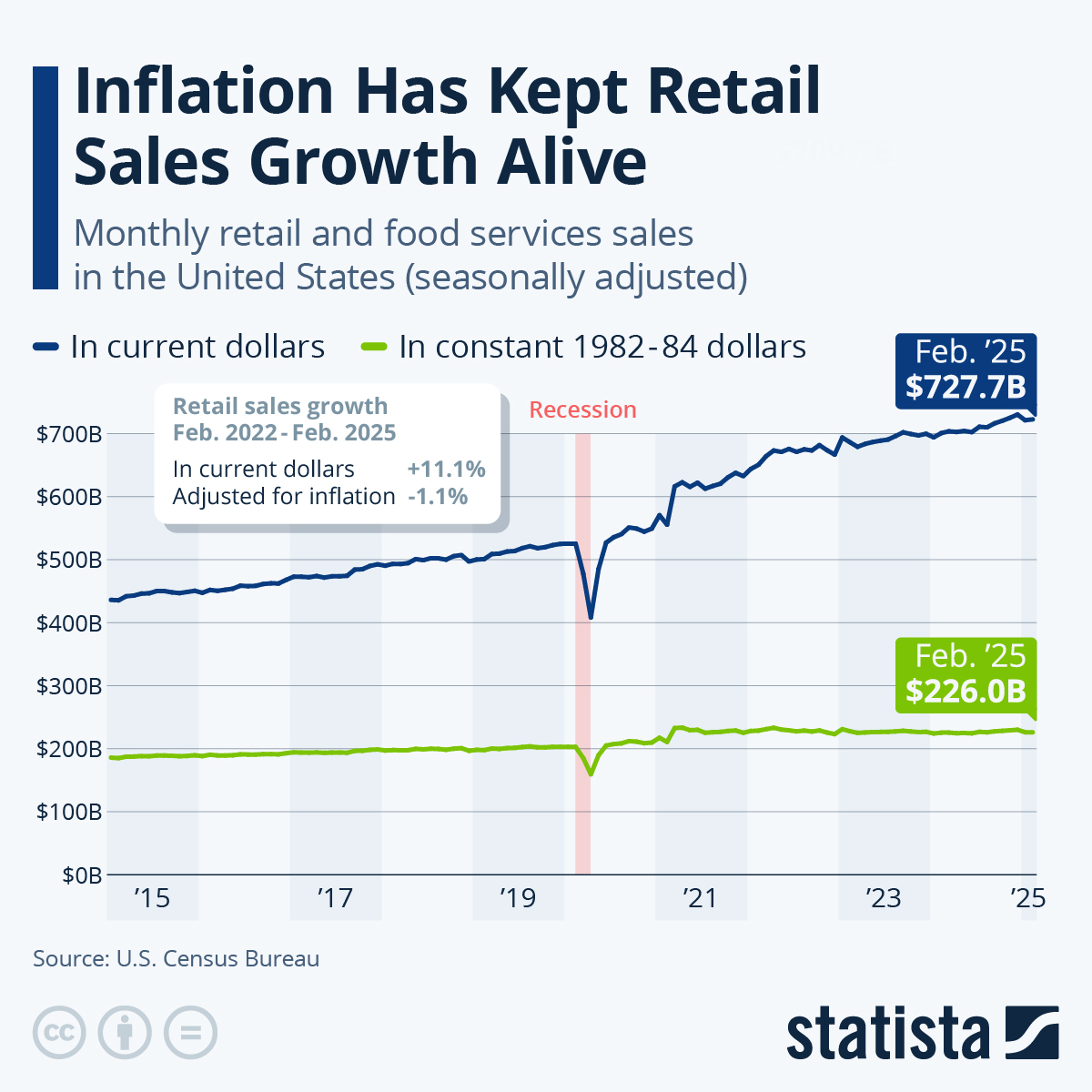
According to advance estimates from the U.S. Census Bureau, U.S. retail and food services sales, which include spending at stores, online and in restaurants, amounted to $757.1 billion in April, up 0.5 percent from the previous month and 4.9 percent from April 2025. Through the first four months of 2026, retail sales increased 4.1 percent compared to the same period of last year, indicating that consumer spending – the largest component of GDP – has remained robust despite the latest, mostly war-related uptick in inflation.
Speaking of inflation, retail sales, which are expressed in nominal terms, grew 0.5 percent in April while consumer prices increased 0.6 percent. In real terms, i.e. adjusted for inflation, retail sales actually declined by 0.1 percent, meaning that consumers were simply spending more for roughly the same amount of goods. In terms of year-over-year growth, retail sales grew 4.9 percent in April, while consumer prices climbed 3.8 percent. That leaves 1.1 percent in "real" spending growth because retail sales outpaced inflation over the past 12 months.
The same cannot be said when looking back five years instead of one. Between April 2021 and April 2026, monthly retail and food services sales (adjusted for seasonal variations, holiday and trading day differences) increased by 24.3 percent. While that sounds like the economy must be humming along nicely, sales were essentially flat when adjusted for inflation. From a positive perspective, that means that Americans haven’t really cut back on their purchases despite the financial pain that inflation has inflicted on many households. From a more negative viewpoint, it means that Americans are spending (a lot) more to keep the same living standard, which is not just bad for consumers but also for retailers trying to actually grow sales.