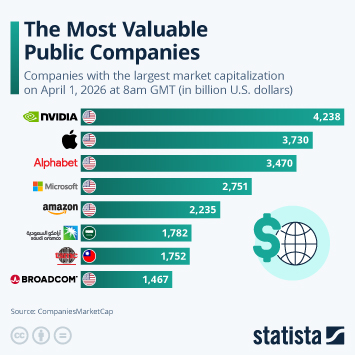
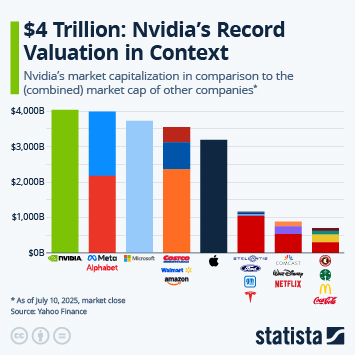
Nvidia's latest earnings announcement on Wednesday followed a familiar script: After weeks of nervous anticipation, Nvidia delivered results that beat expectations, CEO Jensen Huang made the bull case for AI and Wall Street breathed a collective sigh of relief. Only this time, even investors were left impressed. Where Nvidia's share price had repeatedly slumped post-earnings in the recent past, the company's stock soared this time around, bringing Nvidia's market cap close to $5.5 trillion.
A look at the results reveals why investors were left bullish. Despite having tripled its revenue over the past two years, the company’s growth accelerated once more, returning to triple-digits for the first time in two years. In the three months ended July 26, Nvidia’s revenue grew 106 percent from the same period last year, reaching $96.2 billion and beating its own forecast of $91 billion as well as analyst expectations.
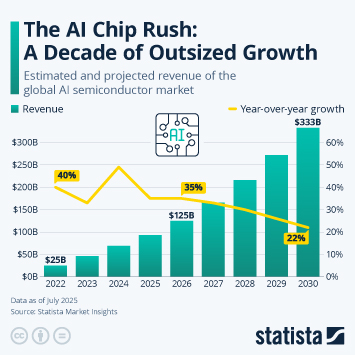
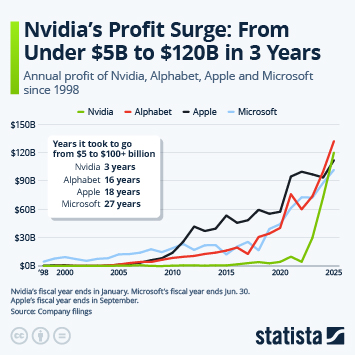
Once again, Nvidia's data center business was at the heart of the company's record-breaking quarter, as it saw a 117-percent increase in revenue versus a year ago and accounted for more than 90 percent of total sales. Net income more than doubled to $59 billion, putting Nvidia safely on track to become the first company to surpass $200 billion in annual profit. For the current quarter, Nvidia expects revenue of $108 billion, which would be equivalent to 89-percent growth.
In his comments accompanying the earnings release, Nvidia CEO Jensen Huang didn't temper his optimism. "AI has reached its inflection point. It’s doing useful work. Its tokens are productive and profitable. Now, compute is revenue," he said, adding that demand was accelerating rather than slowing down. "This time last year, one lab alone was driving the buildout; today, we have a golden age of new AI labs and startups, multiple frontier labs scaling in parallel, a thriving open-model ecosystem and physical AI coming online — with strong momentum across the U.S. and around the world."