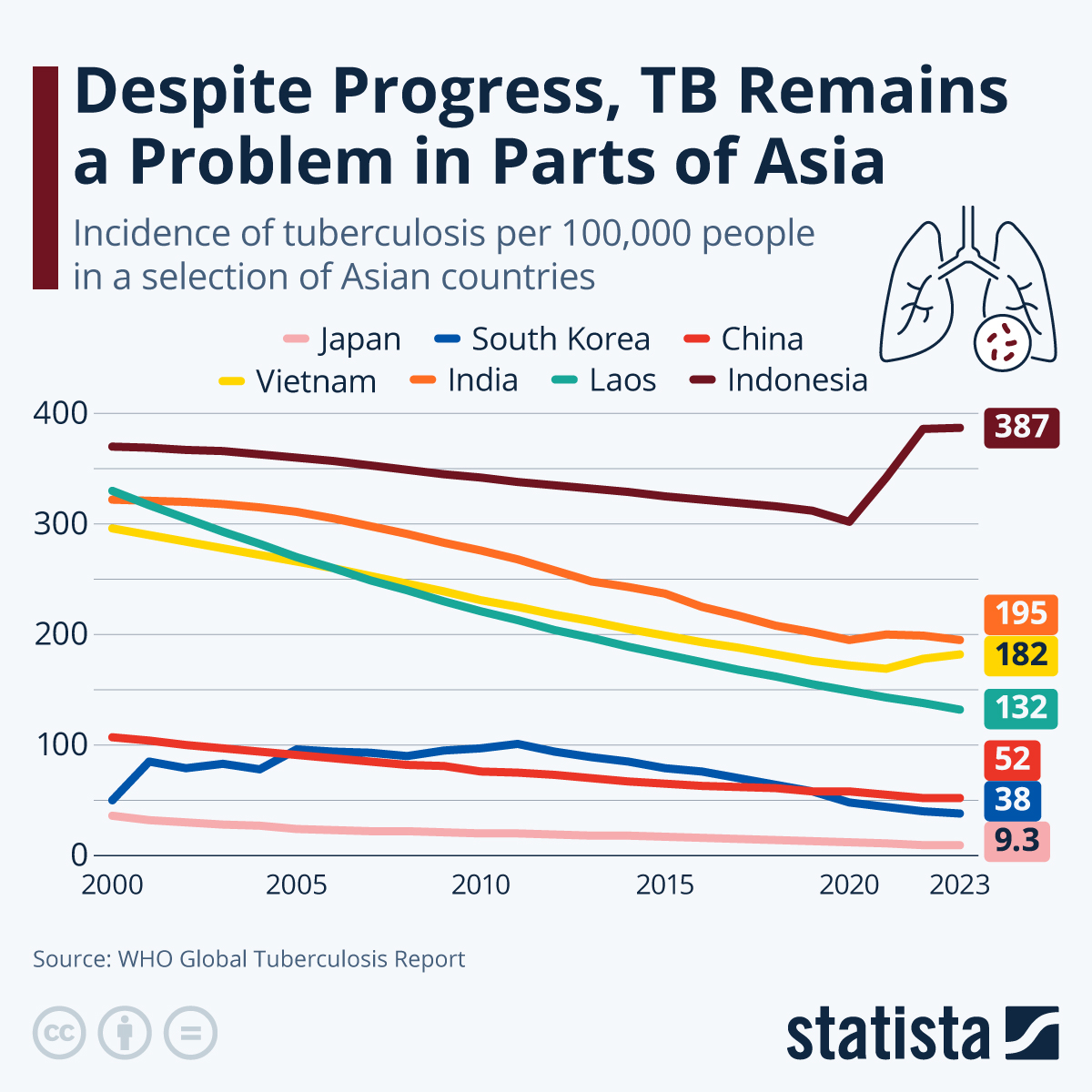
In 2018, India's Prime Minister Narendra Modi pledged to eradicate tuberculosis (TB) from the country by the end of 2025, five years ahead of the global target set by the World Health Organisation. Four months after this deadline, however, TB remains one of the country's most dire public health crises. According to the WHO, India is home to a quarter of the world's TB cases, and records two TB-related deaths every three minutes. In 2024, the country was estimated to have around 2.2 million cases and 300,000 deaths from tuberculosis. Poor case detection, underfunding, health care system gaps and socioeconomic barriers have long stalled the country's efforts to fight the desease, but as our infographic shows, progress has nonetheless been made.
According to data from the most recent WHO Global Tuberculosis report, the number of new cases of TB for 100,000 inhabitants in India has gone from 322 in 2000 to 187 in 2024. Despite this positive evolution, India remains one of the countries in Asia with the highest incidence of the disease. Laos, which saw 330 new cases per 100,000 inhabitants in 2000, saw a steady decline of new cases every year since, recording 127 for 100,000 people in 2024. While Indonesia had seen progress in dealing with TB for two decades, the number of cases in the country bounced back in 2021.
Tuberculosis is an infectious disease caused by a bacteria which mostly affects the lungs, though it can also affect other parts of the body. It can spread easily where people live in crowded conditions, and is more likely to be caught by people with weakened immune systems, for instance those with HIV or AIDS. An estimated 1.61 million people died of TB in 2024 (including roughly 210,000 people with HIV), making it the tenth leading cause of death worldwide. As the WHO underlines, tuberculosis is curable and preventable.