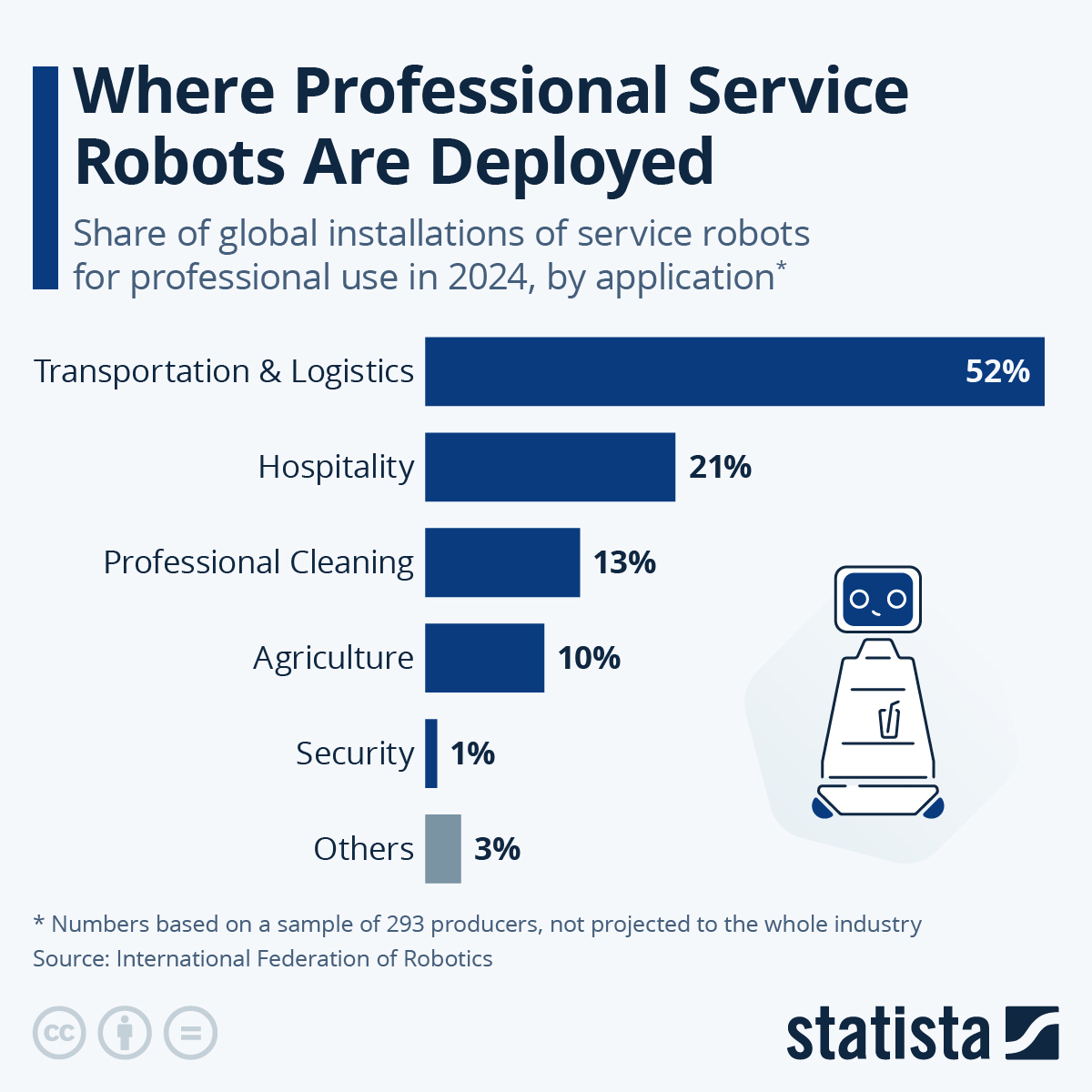
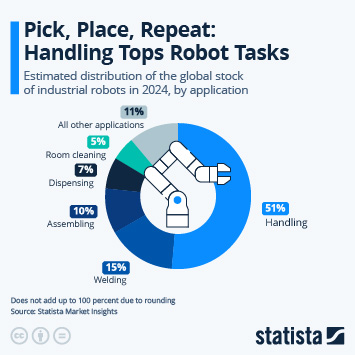
Aside from industrial robots, which have transformed the global manufacturing sector as the operational stock more than tripled from 1.5 to 4.7 million units over the past decade, professional service robots have also made major strides forward. According to data from a sample of 293 service robot suppliers analyzed by the International Federation of Robotics, almost 200,000 service robots for professional use were newly installed globally in 2024, with more than half of that total deployed in transportation and logistics use cases.
Transportation in indoor environments without public traffic is the most important application of professional service robots, as companies like Amazon increasingly rely on robots to handle and move goods inside their giant warehouses and logistics centers. Hospitality robots are in second place, accounting for 21 percent of new installations in 2024. In hospitality, robots are mainly used to provide information, guidance and support in public environments, but in recent years new applications have emerged. Advanced robots used in food and beverage preparation in particular have the potential to revolutionize the food service industry, with fully automated kitchens no longer the stuff of science fiction movies.
Other major use cases for service robots include professional cleaning, mainly floor cleaning, agriculture (e.g. cultivation and milking) and security, where robots are regularly deployed as autonomous surveillance devices – be it in the form of aerial drones or four-legged robots that resemble actual watchdogs.