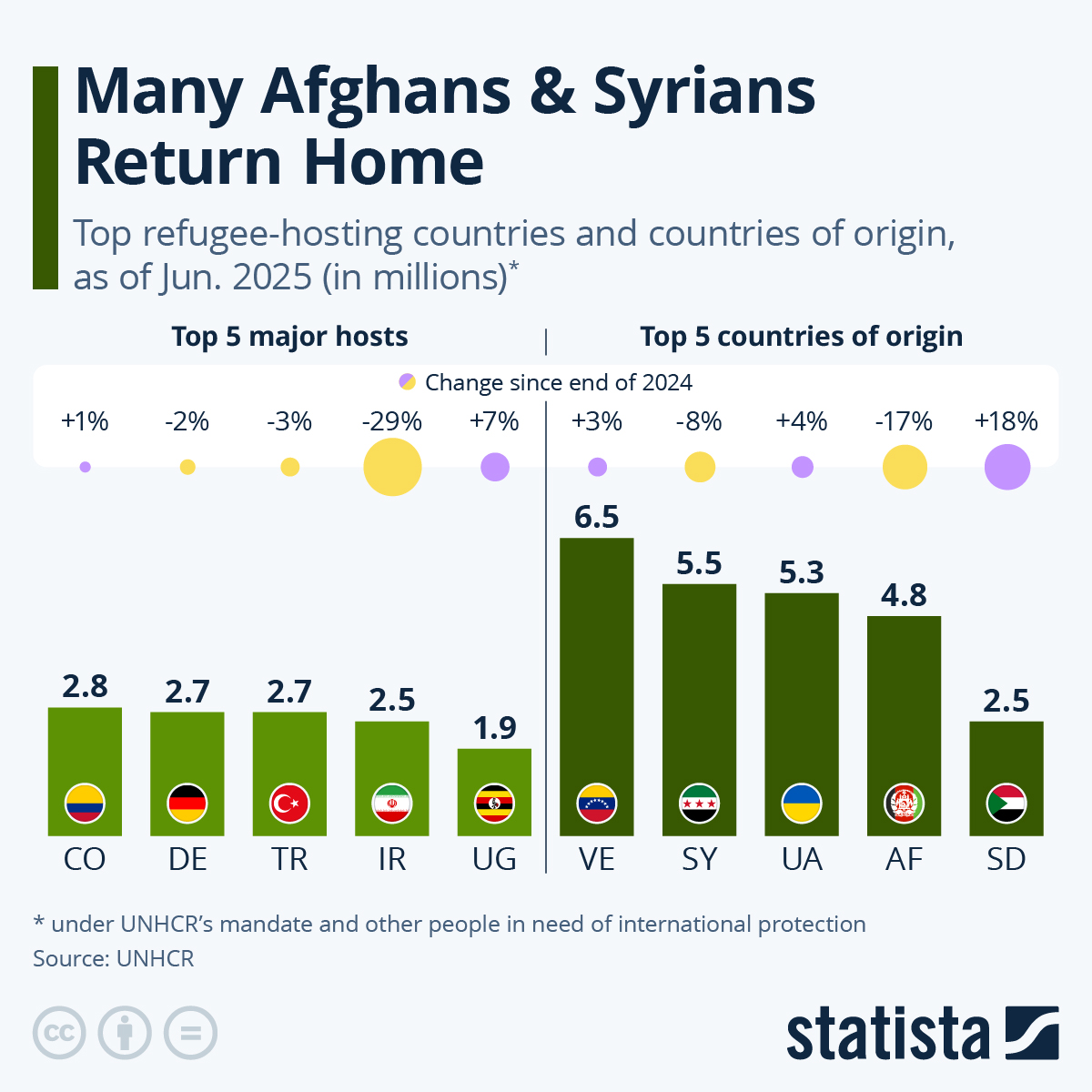
A total of 42.5 million people were reported under refugee status as of mid-2025, marking a one percent decline from the end of 2024 and a two percent fall from 2023. While many new people around the world were forced to flee their homes due to conflict, persecution or climate disasters, large numbers of refugees were estimated to have returned to their home country, namely in Afghanistan (874,800 people) and Syria (526,200). According to UNHCR data, in the first half of 2025, the number of Afghans registered as refugees fell by 17 percent to 4.8 million.
Meanwhile, the number of Syrians registered as refugees fell by eight percent to 5.5 million. This means the number of Syrians account for one in seven refugees globally, down from nearly one in three in 2016. Many Syrians have started to return following the fall of the Assad government in December 2024. The UN highlights that while many more Syrian refugees have signalled that they hope to return to Syria, challenges remain such as insecurity in parts of the country as well as serious damage to the country’s infrastructure in the wake of the war.
According to the UN, 66 percent of the world’s refugees and other people in need of international protection live in countries neighboring their own countries of origin. This is the case with Colombia, which hosts an estimated 2.8 million people in need of protection from neighboring Venezuela. In the first six months of 2025, Colombia saw a slight increase in the number of refugees. UN data shows that the number of Venezuelans falling under refugee or a similar status increased by three percent from the end of 2024, as estimates from Brazil and Chile were updated. The majority of Venezuelans have been granted residence permits and regular stay documentation.
Iran saw a 28 percent decline in the number of refugees and people in a refugee-like situation in the country as of June 2025 amid its major push for Afghan refugees to return home. Daily returns peaked at about 50,000 people in early July, according to the UN, with Iran’s crackdown following a short war between Israel and Iran and subsequent accusations from Iran of Afghans being linked to Israel’s intelligence agency Mossad. The UN condemns the mass returns, as well as the forced or threatened returns from other countries, stating that Afghanistan is not safe for returnees, amid a deteriorating human rights situation.
Turkey too, which is a major host to mainly Syrians, has seen a decrease in the number of refugees in the country since the end of 2024 (-2.7 percent), to a total of 2.7 million. This puts the country now slightly behind Germany, which has taken in a large number of Ukrainian refugees (23 percent of the Ukrainian refugee total) since Russia’s invasion began and is home also to many Syrians. Uganda comes in rank five, with the largest refugee population’s countries of origin South Sudan and the Democratic Republic of Congo.
Together, Afghanistan, Syria, Sudan, Ukraine and Venezuela accounted for two-thirds of all refugees, people in a refugee-like situation or other people in need of international protection. However, most people who are forced to flee never cross an international border, remaining displaced within their own countries. As of June 2025, 67.8 million people were estimated to be internally displaced due to conflict or violence. This marks an eight percent decline from the end of 2024. Sudan remained the largest internal displacement crisis, with many also leaving the country, resulting in 2.5 million refugees living abroad as of June 2025.
These figures only show refugees registered under UN mandates and so actual numbers of people living in need of protection are likely higher.