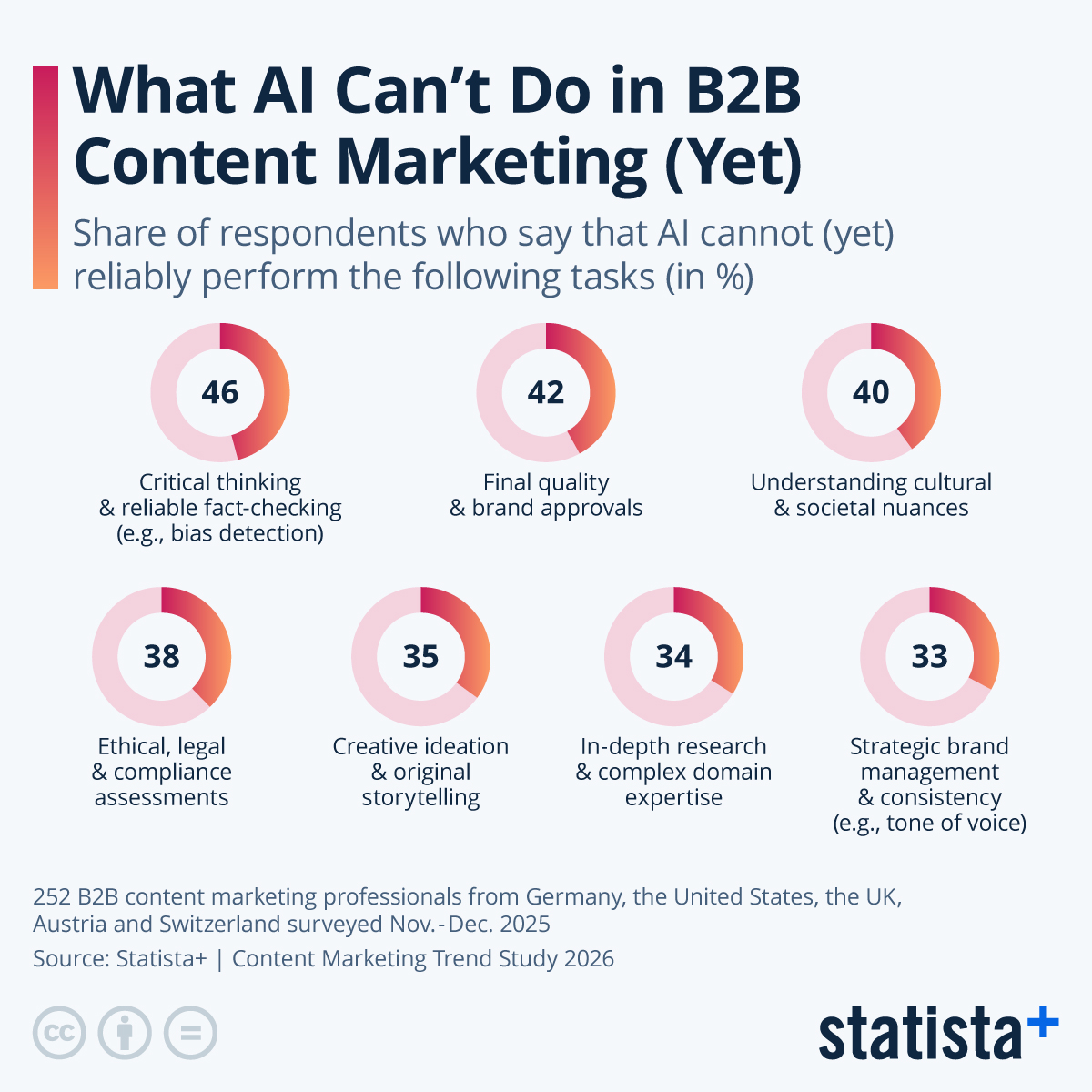
For all its potential, there are still things that AI cannot do in content marketing, at least not yet and not reliably. And while it’s important for marketing professionals to understand and leverage the capabilities of the tools that will re-shape their professional lives over the next few years, it’s just as important to know the limitations of AI in its current state. According to findings from our Statista+Content Marketing Trend Study 2026, marketers are well aware of AI’s shortcomings in areas like critical thinking and nuanced understanding or tasks that do not allow for the inaccuracies that AI-generated results are sometimes plagued with.
As our chart shows, marketers don’t trust AI with final quality and brand approval as well as with ethical, legal and compliance assessments, which still require human oversight – from a liability standpoint alone. Furthermore, critical thinking as well as understanding cultural and societal nuances, both fundamentally human qualities, are areas where marketers recognize AI’s limitations. The same is true for creative and original storytelling, which 35 percent of content marketers don’t think AI can reliably deliver. Perhaps surprisingly, 34 percent of respondents don’t think AI can handle in-depth research or match human domain expertise, despite the fact that deep research is one of the tasks that AI can at least be very helpful with.
To sum up, many marketers understand AI as an assistant, not a decision-maker. By leveraging AI, teams gain the freedom to focus on content quality, differentiation and strategic brand management - skills that remain central to long-term success in B2B content marketing. For more insights on AI in content marketing, download the 8th edition of our B2B Content Marketing Trend Study for free here.