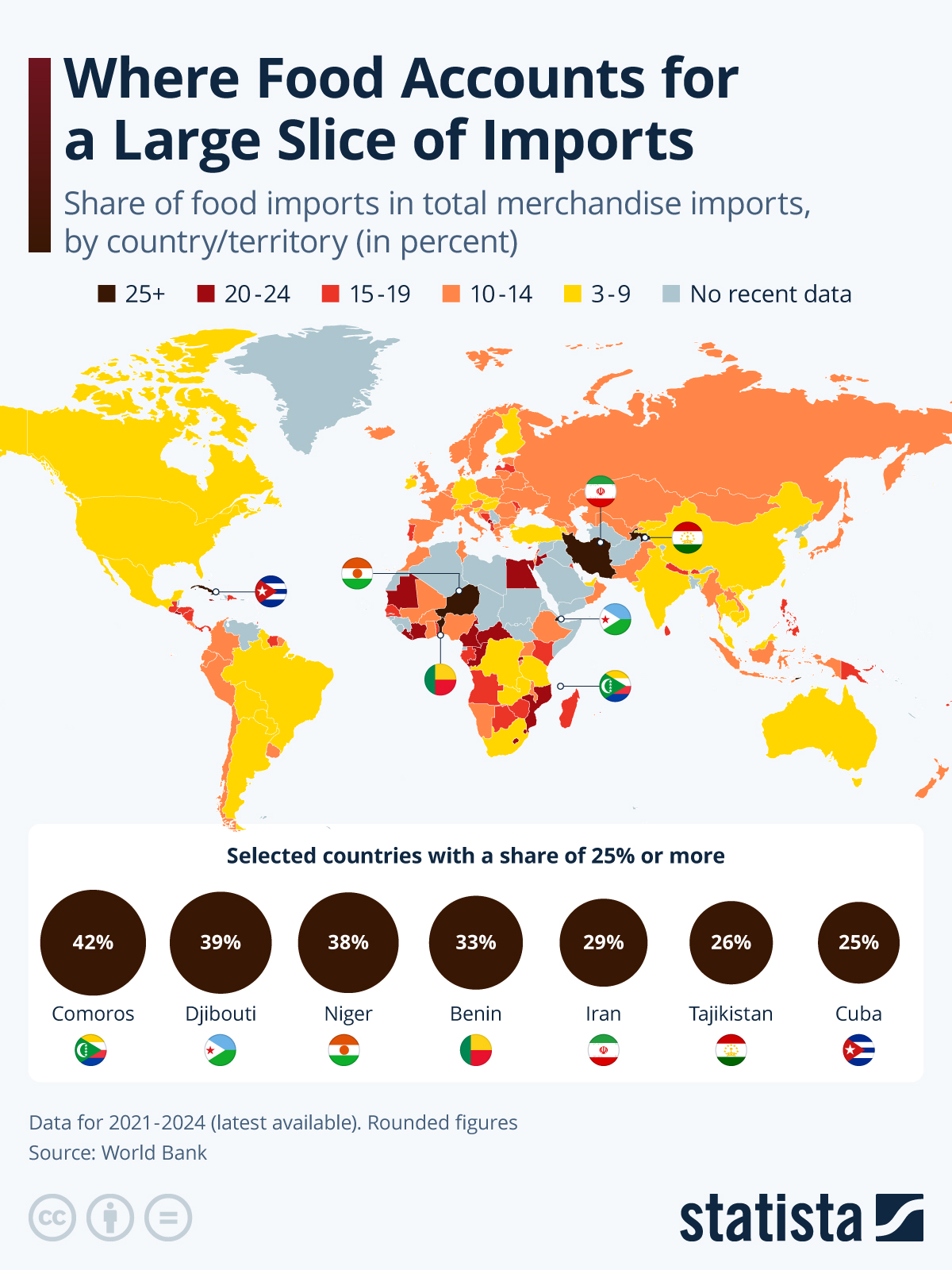
Amid the ongoing conflict in the Middle East and supply chain disruptions caused by the near-total closure of the Strait of Hormuz, concerns over global food security have intensified. The region plays a key role in agricultural trade routes and fertilizer supply, while several countries are themselves heavily reliant on food imports. Disruptions to trade flows, higher transport costs and price volatility risk exacerbating vulnerabilities, particularly in import-dependent economies.
As our map shows, based on the most recent figures available from the World Bank (2021–2024), food imports account for a large share of total merchandise imports in many countries, especially small island states and lower-income nations. In Comoros, food makes up 42 percent of all goods imported, followed by Kiribati (41 percent) and Djibouti (39 percent). Niger (38 percent), Benin and Cape Verde (33 percent each) also rank among the most dependent. Several Middle Eastern and Central Asian countries also appear in the upper range, including Iran (29 percent) and Tajikistan (26 percent), highlighting their exposure to external supply shocks.
A broader regional pattern emerges across Sub-Saharan Africa, parts of the Caribbean and small islands in the Indian Ocean and Pacific, where structural factors such as limited arable land, climate constraints and economic specialization increase reliance on imported food. In contrast, large agricultural producers such as the United States, China, Brazil and India show much lower shares, typically below 10 percent, reflecting stronger domestic production capacity. Overall, the data underline a key vulnerability in the global food system: for many countries, food security is closely tied to international trade. In times of geopolitical instability, this dependence can quickly translate into heightened risks of shortages and rising costs.