Prime Minister Narendra Modi has set his sights on making India one of the world’s top three AI superpowers by 2047, both in consumption and creation of artificial intelligence. To reach that goal, the country is aiming to attract more than $200 billion in AI infrastructure investments over the next two years.
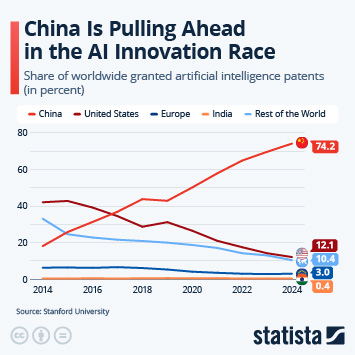
As it stands, India is lagging behind leaders such as the United States and China in core AI infrastructure, private investment, granted AI patents and foundational language models. However, it is seeking to close the gap. Earlier this month, Tata Electronics signed an agreement with Dutch semiconductor equipment maker Advanced Semiconductor Materials Lithography (ASML) to build India’s first front-end semiconductor fabrication plant, marking part of a broader push to establish a domestic chip industry currently dominated by regional players such as Taiwan.
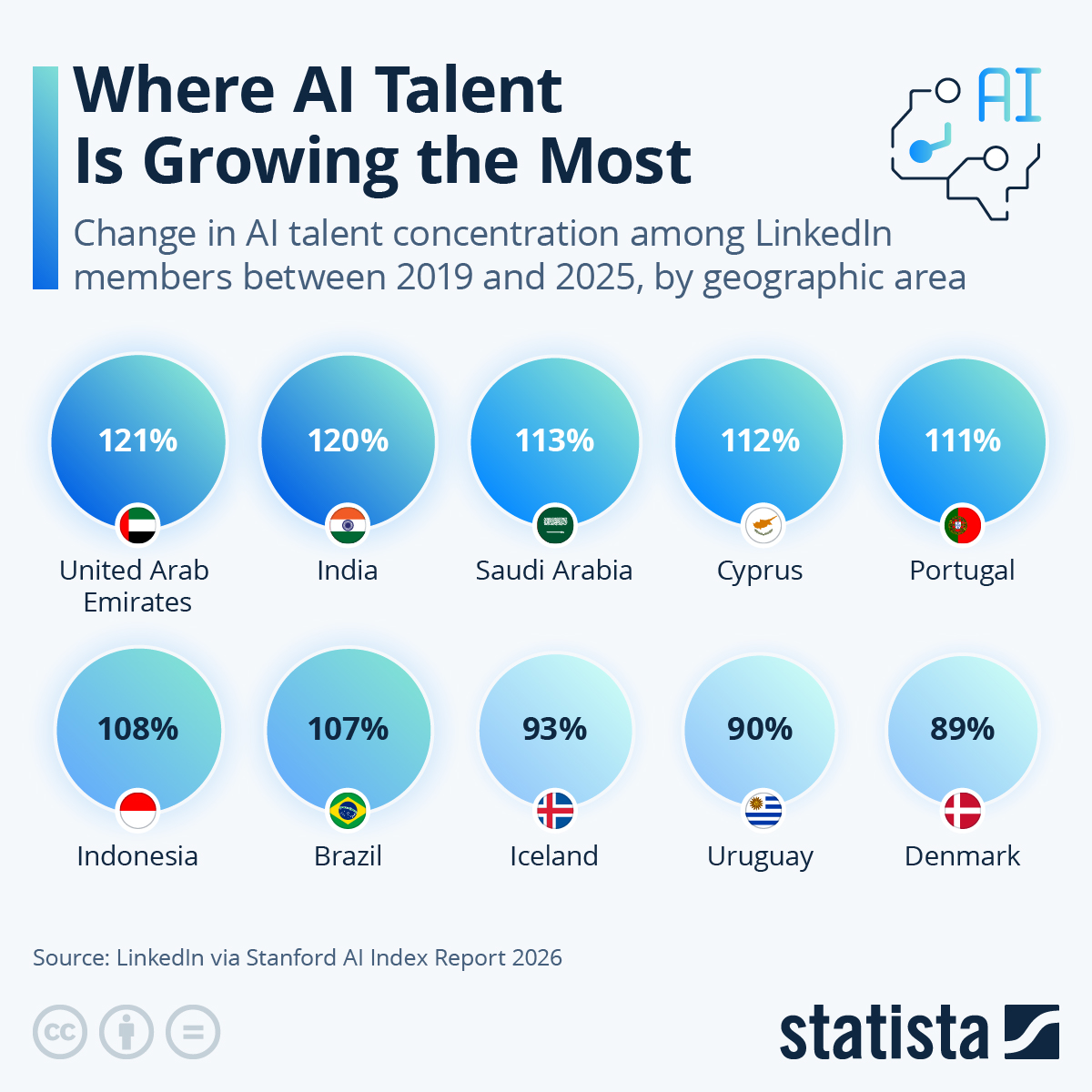
One of India’s biggest strengths is its growing AI talent pool and its population's rapid adoption of AI technologies. A LinkedIn study cited in Stanford University’s 2026 AI Index report found India recorded the world’s second-fastest AI talent growth among LinkedIn users between 2019 and 2025, rising 120 percent, behind only the United Arab Emirates. India also ranked first globally in AI skill penetration on LinkedIn, with AI-related skills appearing on member profiles nearly three times more often than the global average. The United States ranked second, followed by Germany.
Retaining top-tier AI talent remains a challenge, however. India recorded the world’s largest net outflow of AI authors and inventors in 2025, with a net flow score of -16.9, meaning more specialists left the country than moved to it. Canada and Germany also posted negative flows, while the United States remained net positive, though its gains have sharply declined from 324.6 in 2022 (rolling average) to 26.0 in 2025, indicating slower talent inflows.
India has also emerged as a major hub for AI offshoring. According to a Nasscom and Zinnov report, more than one-third of Fortune 500 companies operate global capability centers (GCCs) in the country, supporting functions such as IT, engineering and research. India now hosts 2,117 GCCs employing an estimated 2.36 million people, accounting for roughly 28 percent of the global GCC AI talent pool and making it the world’s second-largest employer of enterprise AI talent after the United States.
AI sovereignty has become an important talking point for India’s strategy. Business leaders say the country must move beyond being primarily an AI consumer and now focus on building indigenous models which are tailored to Indian languages and the country's social needs. At a recent summit, speakers stated that AI development should support priorities in healthcare, education, agriculture and financial inclusion, helping citizens to access services in local languages and to improve their quality of life.