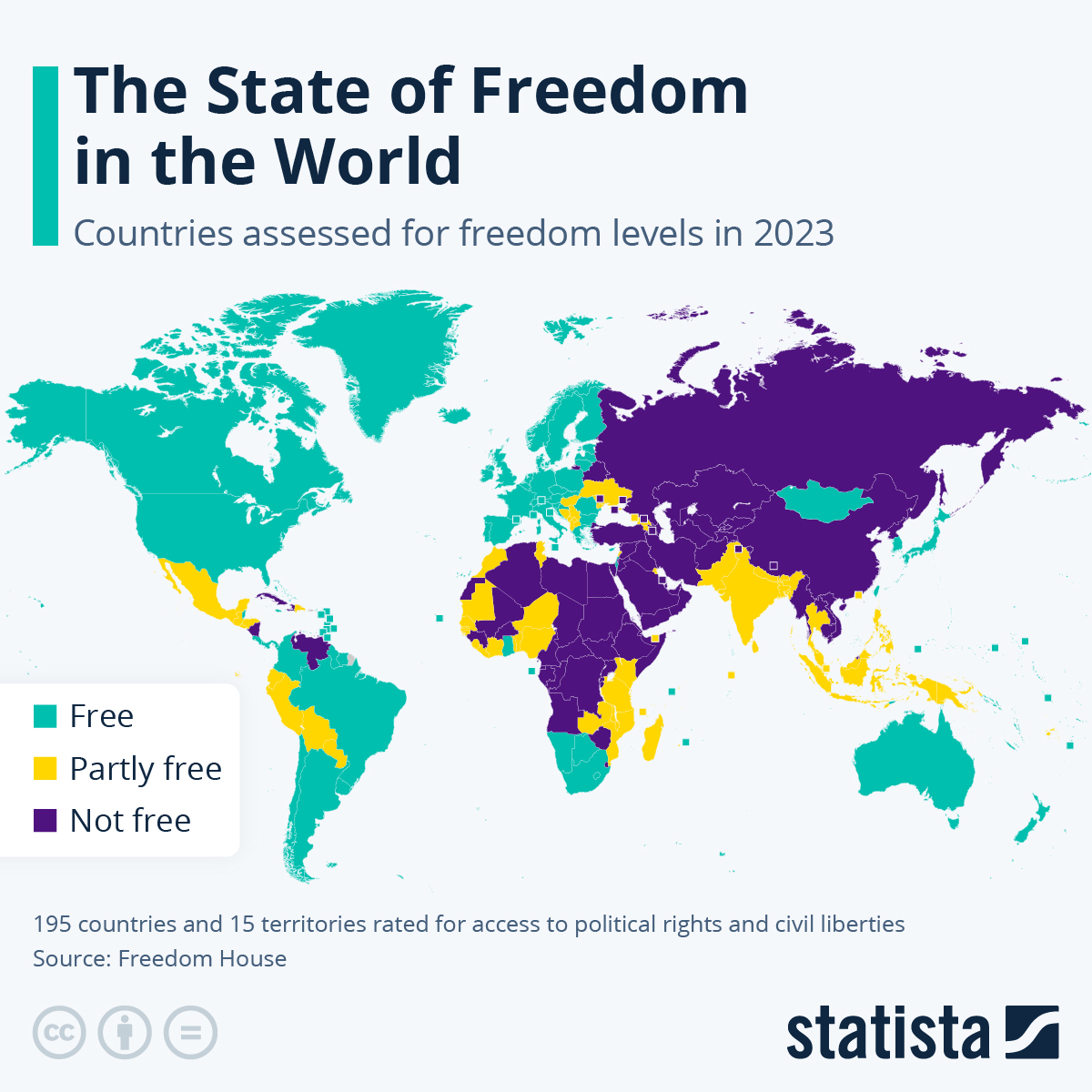
Global freedom declined for the 20th consecutive year in 2025. That's according to to Freedom House's latest Freedom in the World report, which found that 54 countries have experienced a deterioration in their political and civil liberties last year, while only 35 countries saw improvements. Guinea-Bissau, Tanzania, Burkina Faso, Madagascar and El Salvador saw their scores drop the furthest compared to last year, while while Syria, Sri Lanka, Bolivia and Gabon saw the biggest gains.
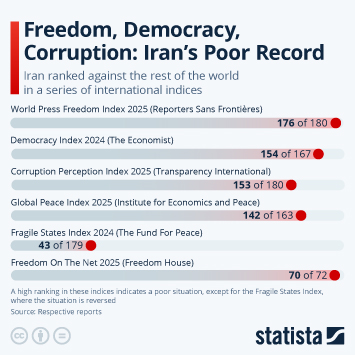
Among the countries considered "not free", Sudan, Myanmar and Iran recorded further declines in their scores, as armed conflict and authoritarian repression resulted in profound human rights violations. Meanwhile the scores for Russia and China remained unchanged at 12 and 9 out of 100, respectively, as both countries continue to suppress anything resembling dissent, thereby crippling people's political and civil liberties.
Among the countries rated "free", Bulgaria, Italy and the United States saw the biggest declines. While Bulgaria and Italy saw their scores reduced in the face of widespread public corruption, the decline in freedom in the U.S. was attributed to a combination of long-term trends, such as chronic partisan gridlock, and more recent developments, i.e. the executive branch's assertion of unilateral authority and its threats and reprisals against any political opposition.
Overall, just three countries were assigned a new status, as Bolivia, Fiji and Malawi were upgraded from "partly free" to "free". According to Freedom House, these changes were driven by competitive national elections as well as growing judicial independence and strengthening of the rule of law.
The Freedom in the World Index is an index compiled annually by the U.S. NGO Freedom House, which evaluates civil and political freedom in states and territories around the world. The methodology is based on the Declaration of Human Rights as proclaimed by the United Nations (UN) in 1948 and is intended to assess the political rights and civil liberties of individuals rather than governments.
The countries/territories are evaluated by a team of internal and external analysts and expert advisors from a range of academia, think tanks and human rights communities, with the final scores being the result of a consensus between the analysts, a panel of outside advisors and Freedom House staff. Depending on the weighted index score for political rights and civil liberties, a country is classified as "free", "partly free" or "not free".