In the 2024 Eurovision Song Contest, almost half of song entries contained a language other than English. After winning songs in Portuguese in 2017, Italian in 2021 and Ukrainian in 2022, songs in participant countries' languages (or third languages) rose to a high of 49 percent. This is projected to increase even more to 62 percent in this year's installment.
Countries have been free to choose the language in which they sing since 1999 and after that date, many have opted for lingua franca English to get their message across to the international audience of the annual song competition. But, as a detailed analysis by blog Johnthego.com shows, winning titles in languages other than English have in the past inspired more countries to present a song in their native tongue.
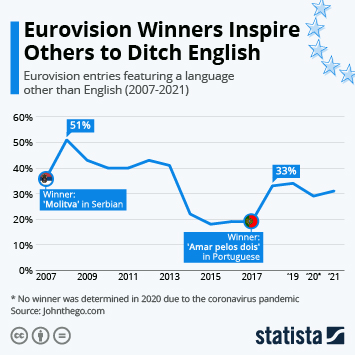
In 2007, winning title "Molitva" (Prayer) performed by Serbian Marija Šerifović was one of 36 percent of titles which featured languages other than English. In the following year, more than half of artists suddenly wanted to give a language other than English a go. But it was more likely Šerifović’s emotional performance and the song’s powerful choral chorus that won her the title, since the following years’ focus did not earn another local-language song a title. Interest waned and reached a low of less than 20 percent of songs offering language variety between 2015 and 2017.
2016’s winner, "1944" by singer Jamala, contained some Ukrainian verses, but things only changed again after the surprise win of contestant Salvador Sobral with his quirky Portuguese ballad "Amar Pelos Dois" (To Love for the Both of Us) in 2017. Language variety went up again to 33 percent in 2018 and 34 percent in 2019. In 2021, this number stood at 31 percent when Italian rock band Måneskin won with their song "Zitti e buoni" (Shut up and behave). The following year, at 43 percent non-English language participation, Ukrainian had a moment again when Kalush Orchestra performed "Stefania" just a couple of months after the Russian full-scale invasion.
Not included in the count is the trend of spicing English songs up with foreign language titles, like Cyprus’ El Diablo, Malta’s Je me Casse or San Marino’s Adrenalina. Serbia employs a similar tactic for its 2021 entry Loco Loco, which contains mostly Serbian, but mixes in Spanish and English.
The record for most languages featured in a single Eurovision song stands at four. Israel’s 2020 entry by singer Eden Alene featured Hebrew, English, Arabic and Amharic, a language from her parents’ home country of Ethiopia. The second Eurovision song containing four languages is also tied to Israel. Germany’s 1999 entry "Reise nach Jerusalem" (Journey to Jerusalem) for the competition held in the same city was sung in German, English, Turkish and Hebrew.