Imagine getting home from your nine-to-five job to have dinner with your family, maybe read a bedtime story and put your kids to bed. But instead of winding down on the couch afterwards, you get ready and start your second workday. That’s the daily reality for millions of Americans, for whom one job is no longer enough to pay rent, put food on the table and cover other expenses.
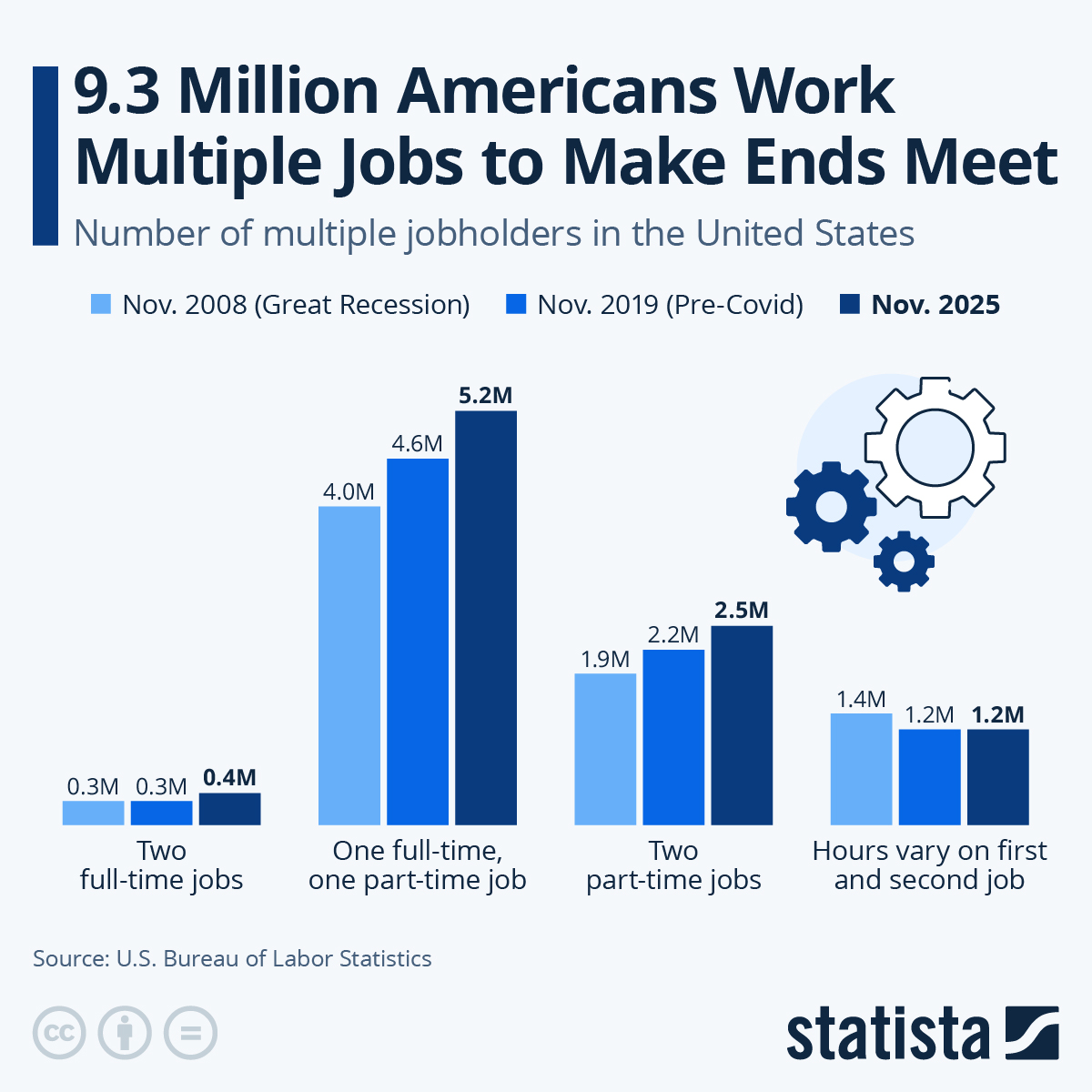
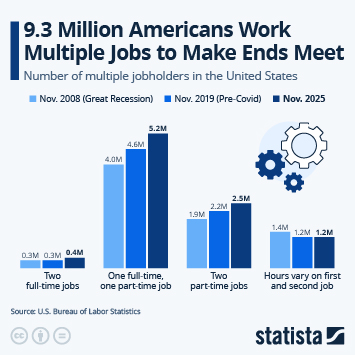
According to the U.S. Bureau of Labor Statistics, 9.3 million Americans reported working multiple jobs in November 2025 – the highest number ever recorded since the BLS started tracking multiple jobholders in 1994. In relative terms, 5.7 percent of employed Americans worked more than one job last month, which is also the highest share in 25 years. Only in the mid-1990s, when the workforce was considerably smaller than it is today, was the share of multiple job holders higher, peaking at 6.5 percent in November 1996. But whereas in 1996, around two thirds of multiple jobholders were not college-educated and presumably worked in low-wage occupations, half of those working more than one job now do hold a college degree, indicating that even an advanced degree no longer guarantees a job that pays well enough to make ends meet.
There are several reasons behind this trend, the most important one being economic necessity: several years of elevated inflation have left a legacy of high prices while wages have barely kept up. Housing costs, for example, have risen 28 percent over the past five years, while wages have only increased 24 percent. That leaves many families financially strained, especially as the prices of other necessities, food in particular, have also outpaced wage growth.
Another reason for the rise in multiple jobholders is the changing labor market: for one, the rise of remote jobs has made it easier for many people to work a second job, possibly from home. Then there’s the availability of jobs in general: for large parts of the past few years, the number of job openings has vastly exceeded the number of job seekers, leaving workers willing to earn an extra paycheck with plenty of options. And finally, the gig economy has created new opportunities for people to complement their income, offering flexible work schedules and relative freedom. As our chart shows, most multiple jobholders have one full-time and one part-time job, while two full-time jobs is the rarest form of multiple employment.