Released on March 19, the latest Freedom in the World 2026 report finds that global freedom declined for the 20th consecutive year in 2025, with more countries experiencing deterioration in political rights and civil liberties than improvements. According to Freedom House, 54 countries saw their scores worsen, compared with just 35 registering gains, as armed conflict, coups and the erosion of democratic institutions continued to weigh on freedom worldwide.
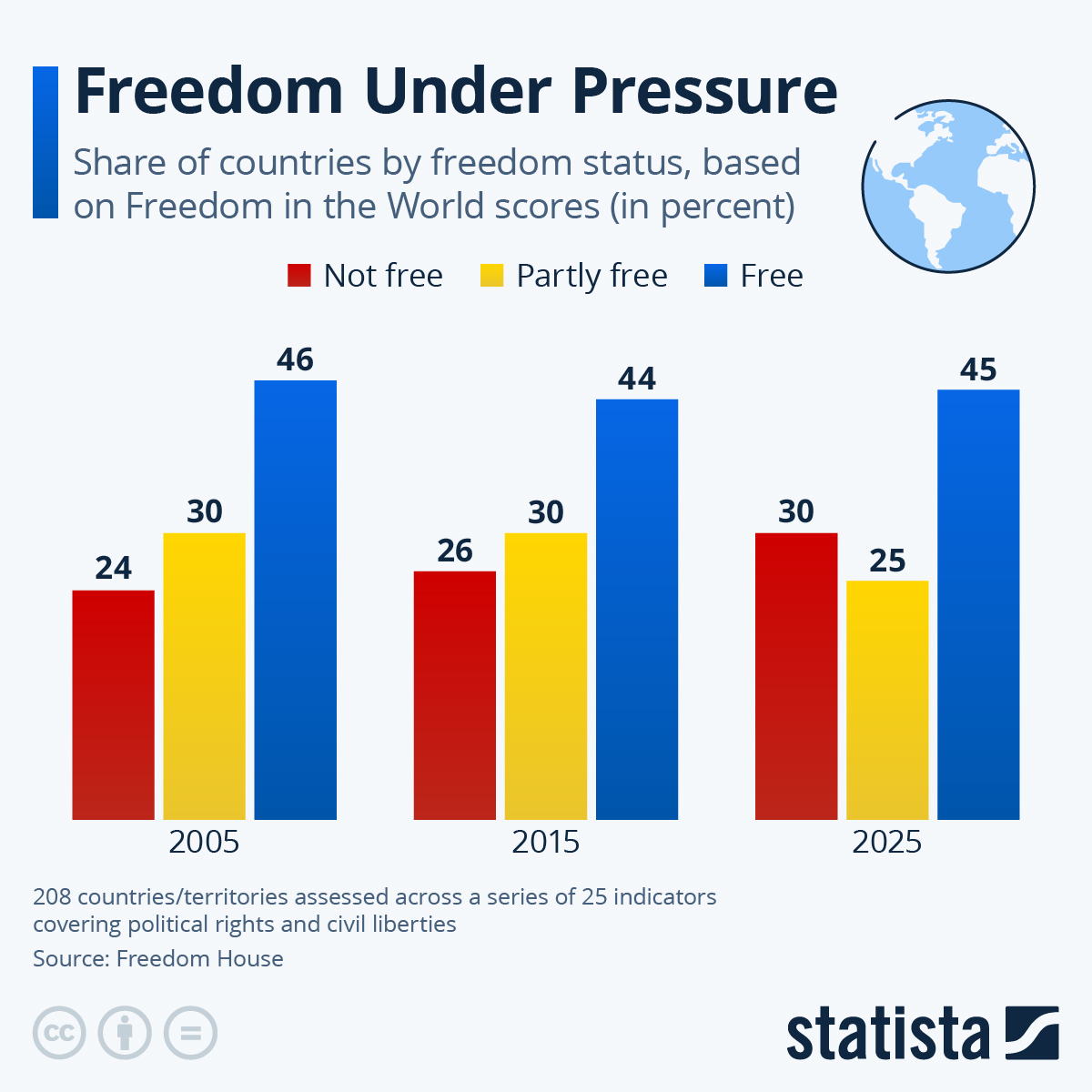
This long-term trend is also reflected in the distribution of countries by freedom status. While the share of countries classified as “Free” has remained broadly stable since 2005, at around 45 percent, the proportion of “not free” countries has increased (from 25 to 30 percent), mainly at the expense of those rated “partly free” (from 30 to 25 percent). In fact, many countries that once occupied a middle ground have shifted toward more authoritarian forms of governance. Over the past two decades, 19 countries have fallen from “partly free” to “not free”, contributing to the expansion of the world’s autocracies, while only a limited number have improved their status and consolidated democratic institutions.
Among the most striking declines over the past two decades are countries such as Nicaragua and Venezuela, where democratic institutions have been steadily dismantled, as well as Mali, which has seen one of the largest score drops since 2005 following repeated coups. Elsewhere, notable setbacks have been recorded in countries such as Turkey and Hungary, while the United States has lost more points than any other country still classified as “free”. On the other hand, some countries have made meaningful progress, including Fiji and Malawi, which recently improved their status to “free”, alongside longer-term gains in countries such as Nepal ("partly free), Bhutan ("free") and Côte d’Ivoire ("partly free").