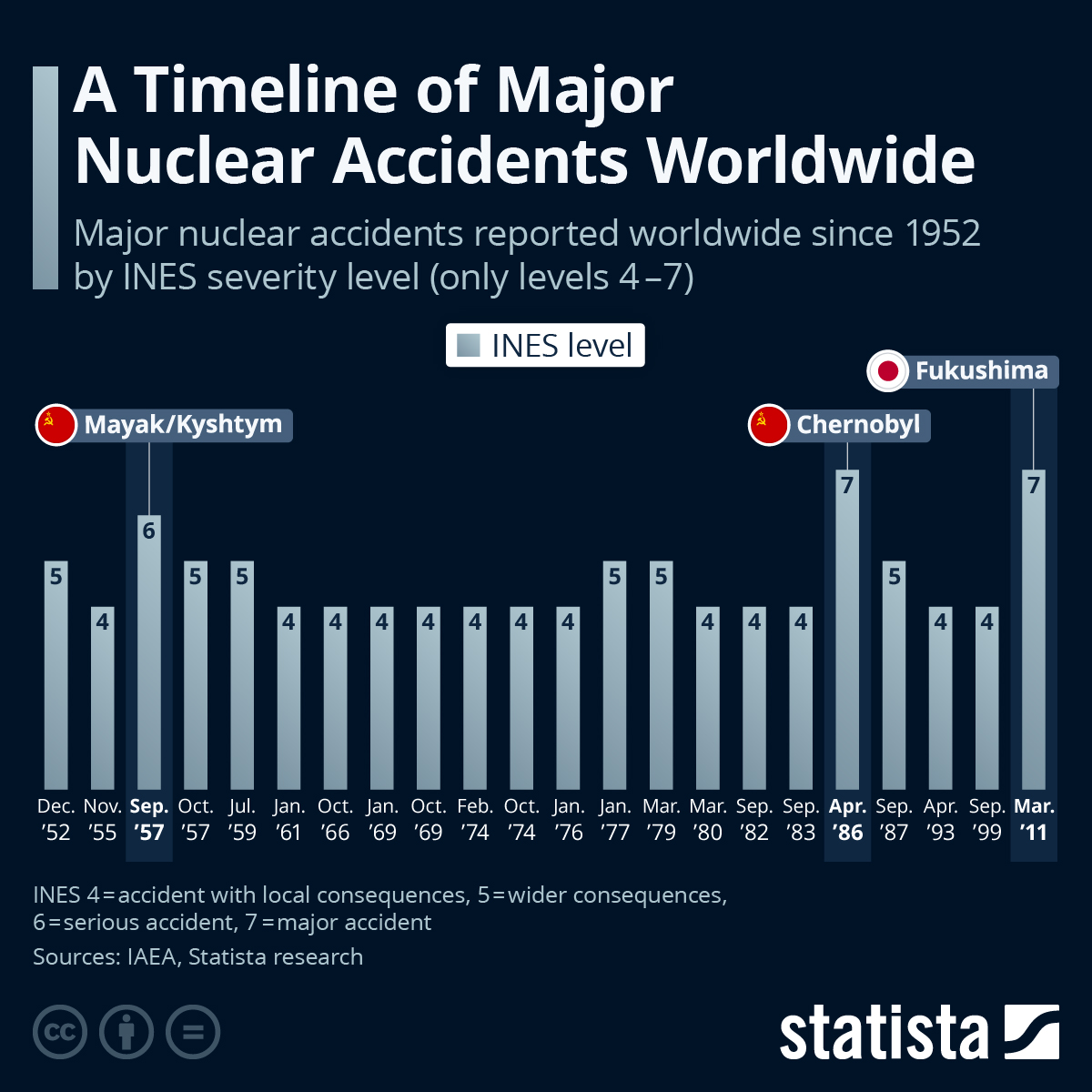
April 26, 2026, marks the 40th anniversary of the Chernobyl disaster, the most severe nuclear accident in history. On this occasion, the timeline below looks at major nuclear accidents reported worldwide since 1952 (INES levels 4 = “local consequences” to 7 = “widespread, long-term impacts”), offering a perspective on how the frequency and nature of such events have evolved over the past eight decades.
The data show that serious incidents were more frequent in the early decades of nuclear power, particularly between the 1950s and the late 1980s, with about twenty accidents classified as levels 4 to 7 recorded over thirty years. This period includes some of the most significant accidents: the 1957 Kyshtym disaster in the Soviet Union (level 6), caused by a failure in nuclear waste storage; the 1979 Three Mile Island accident in the United States (level 5), linked to a combination of equipment malfunctions and operator errors; and, most notably, the 1986 Chernobyl disaster (level 7), where a flawed reactor design and unsafe testing procedures triggered an uncontrolled reaction and widespread radioactive release.
Since Chernobyl, the number of major accidents reported has declined significantly (four accidents classified as levels 4 to 7 recorded since 1987), reflecting tighter safety standards, improved regulatory oversight and advances in reactor technology. However, the timeline also highlights that risks have not disappeared entirely. The 2011 Fukushima disaster in Japan (level 7), triggered by a powerful earthquake and tsunami, showed how external events can overwhelm safety systems, leading to multiple reactor meltdowns and renewed global scrutiny of nuclear safety.
While major accidents have become rarer thanks to technological and institutional improvements, the potential consequences remain extremely severe. As nuclear power gains renewed interest in low‑carbon energy strategies in some countries (e.g., China, France, UK), maintaining high safety standards and advancing safer reactor designs – particularly those incorporating passive safety systems – are essential to balancing the benefits and risks of this technology.