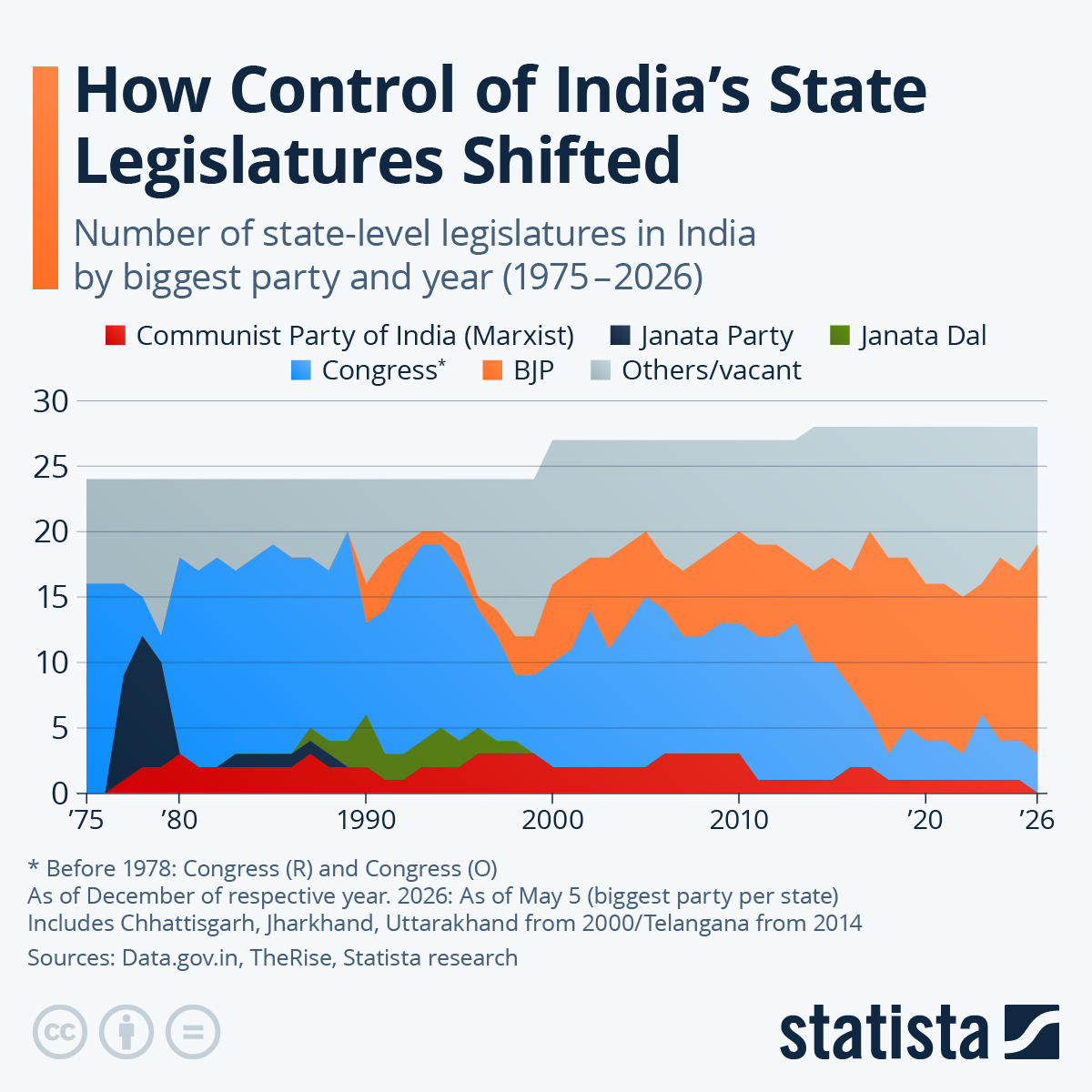
For the first time in more than 35 years, a single party will be in charge of 16 Indian states' legislative assemblies, matching the previous record set by the Indian National Congress. On Monday, news broke that prime minister Narendra Modi's Bharatiya Janata Party will lead the West Bengal legislature, upping direct control of state assemblies to 16 from 13 at the end of 2025, as new BJP-led legislatures also formed recently in Bihar and Manipur. The last time one party controlled this many states was in 1989 when the INC led 16 state legislatures of then 24 states. (Chhattisgarh, Jharkhand and Uttarakhand did not become states until 2000 while Telangana was created in 2014). Congress also had 16 state legislatures in its name around 1975 to 1977.
Including the BJP's allies of the National Democratic Alliance as well as Union Territory assemblies, the tally of BJP-controlled regional assemblies rises to 23 out of a total of 32 (or 72 percent). Considering population, almost 78 percent of Indians will live under a local assembly led by the BJP or its allies.
In 2016, ten years ago, the BJP had controlled just nine state assemblies. However, at the same, it had already won its absolute majority in the Indian national parliament. After that was lost in 2024, the party has focused heavily on state legislatures, achieving Monday's surprise win in West Bengal. Together with its alliance, the BJP still has control of a majority of the Lok Sabha.
A look back at control at Indian state assemblies since 1975 shows how India's political landscape remains fragmented, but has seen phases of consolidation, like is currently ongoing under the BJP or happened in the 1980s and 1990s in the modern heyday of the Indian National Congress. Previously, the country went through a lot of turmoil in the 1970s, also visible in the leadership of state assemblies. The Janata Party formed in 1977 in opposition to Congress Prime Minister Indira Gandhi's state of emergency declaration following her being found liable for electoral malpractice. It was formed from Congress' split O faction, the Socialist Party, the center-left Bharatiya Lok Dal and the Hindu-nationalist party Bharatiya Jana Sangh, whose former members would later create the BJP. The party won the national elections the same year and by 1978 had taken over 10 state assemblies either by forcing new elections or by existing assembly members joining the movement. When Gandhi was reelected in 1980 after the Janata government fell apart, her Indian National Congress Party reversed these gains quickly.
History repeated in 1989 when another newly-formed big tent party, Janata Dal, went on to defeat Congress nationally once more. The party's government which unified an even broader range of political ideologies from marxists, left-leaners, farmers, regional parties, right-wingers and nationalists was even more short lived and collapsed within a year. However, at the height of the party's influence in 1990 it controlled four state legislatures.
The Communist Party of India (Marxist) had a more consistent presence in the country's regional politics, but as of 2026 leads no more state assemblies after losing to Congress in Kerala this year. The state's majority has switched between the CPI (M) and Congress many times since 1957. In West Bengal, the party was in power continuously from 1977 to 2011, constituting the longest democratically elected communist-led governance in the world. In Tripura in India's northeast, the party was in charge from 1978 to 1988 and again from 1993 to 2017, before making way for the BJP.