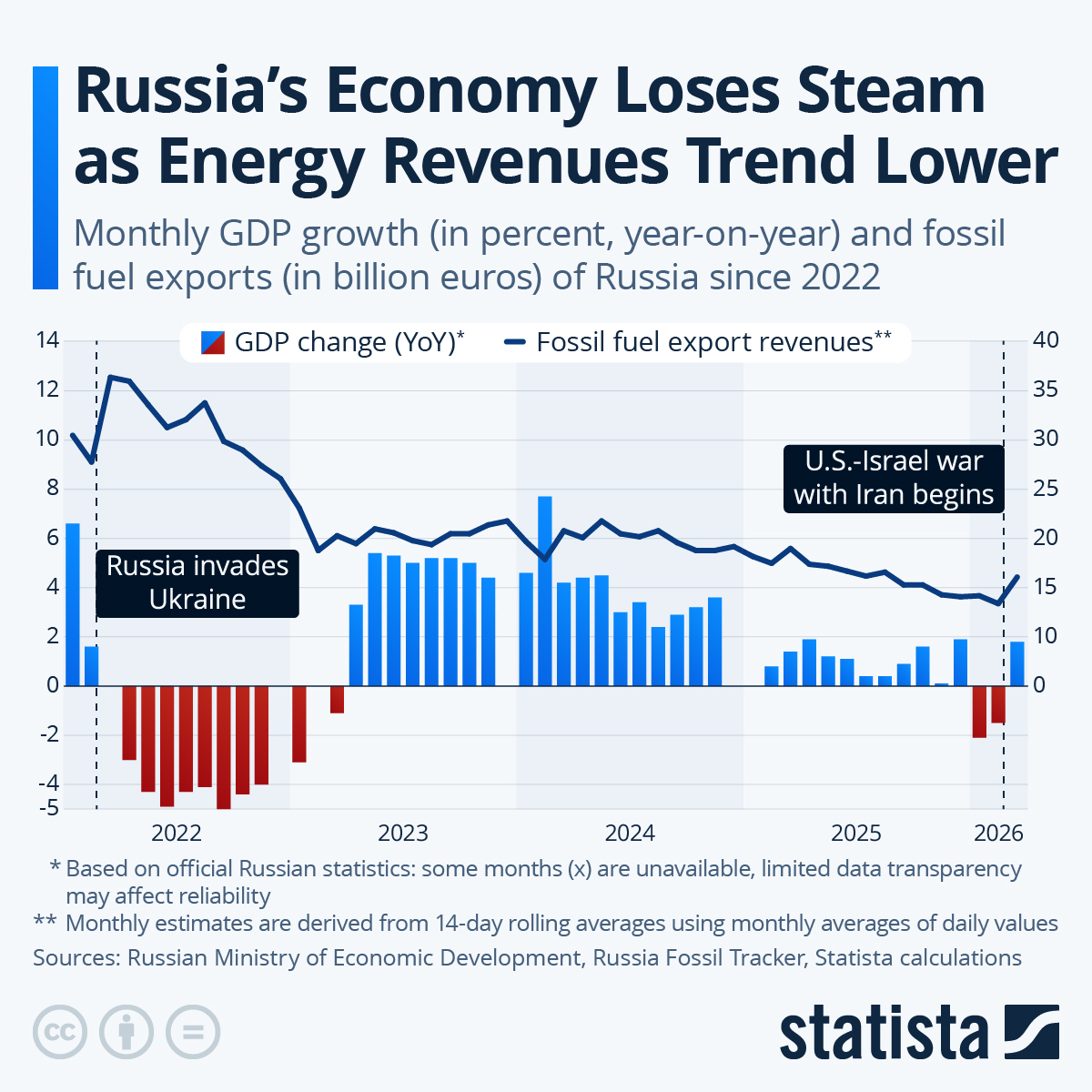
Russia’s economic momentum appears to be fading, with recent data pointing to renewed weakness at the start of 2026. After posting solid growth throughout much of 2023 and 2024, the country’s GDP contracted year-on-year in both January (-2.1 percent) and February 2026 (-1.5 percent), according to official Russian statistics, highlighting growing strains on the economy more than four years into the war in Ukraine.
As our chart shows, this cooling trend comes alongside a gradual decline in fossil fuel export revenues, still a key pillar of Russia’s economic model. After the initial shock of the full-scale invasion in 2022, the economy proved more resilient than many had expected, returning to steady growth in 2023 and into 2024. This rebound was supported by still-elevated energy revenues, which, despite falling from monthly average peaks above €30 billion in 2022, stabilized at around €20 billion through much of the following two years, according to data from CREA's Russia Fossil Tracker (derived from 14-day running averages).
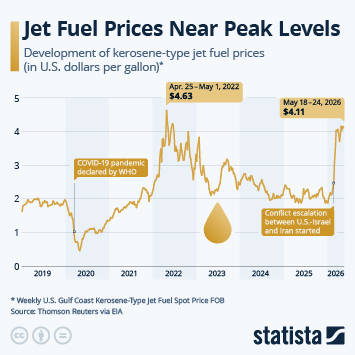
More recently, however, both indicators have weakened. By 2025, monthly export revenues had slipped into the mid-teen billions, while GDP growth slowed markedly, nearing stagnation in the second half of the year before turning negative at the start of 2026. While a recent spike in fuel prices linked to the escalation of the U.S.-Israel conflict with Iran has temporarily lifted export revenues (and GDP growth), the broader trend remains downward. This reflects not only Russia’s continued dependence on fossil fuel income but also mounting structural pressures, including Ukrainian attacks on oil infrastructure and the long-lasting effects of Western sanctions, which continue to limit Moscow’s ability to diversify its export markets.