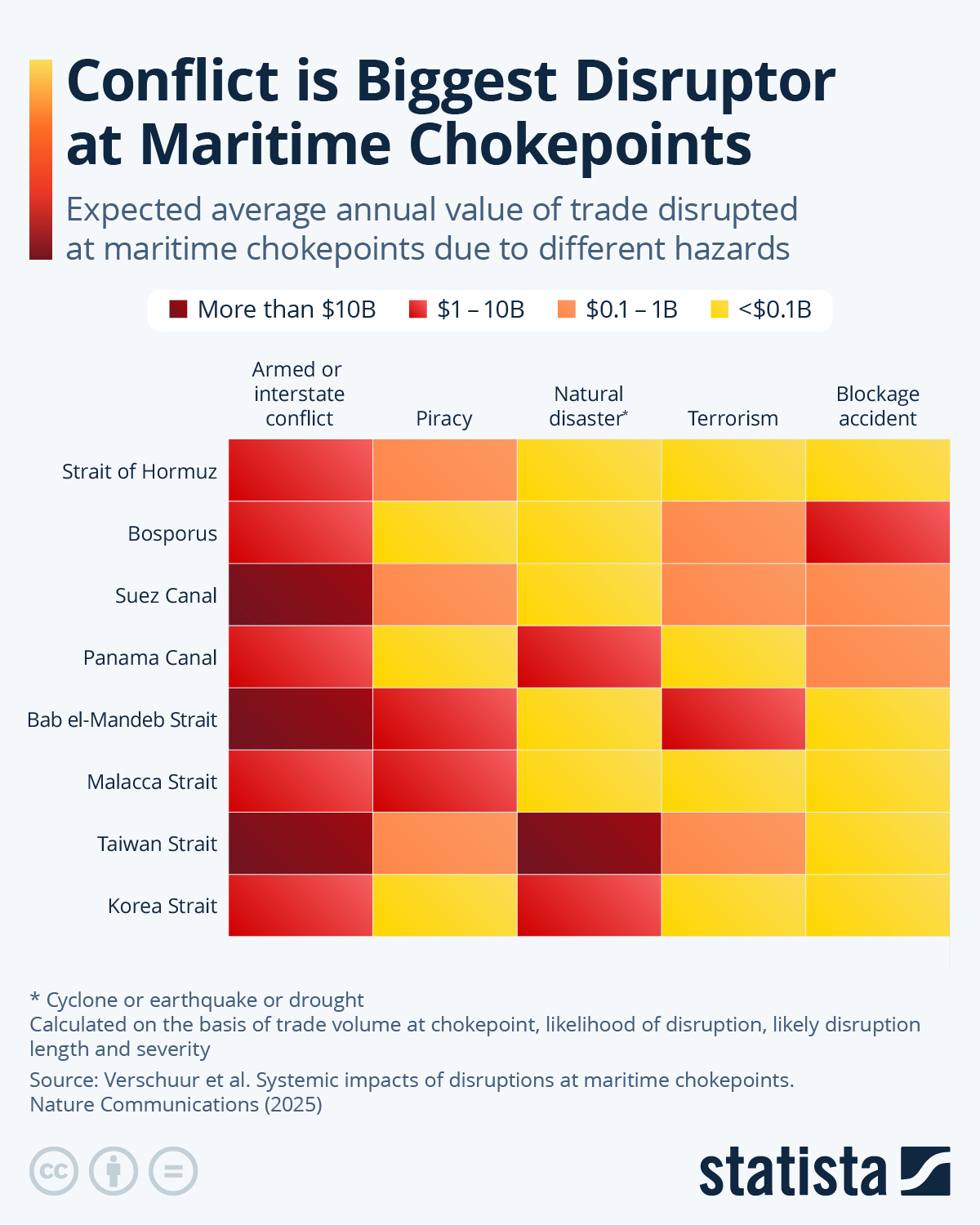
Conflict disruptions are expected to affect the highest value of goods at maritime chokepoints globally, a study released in 2025 in Nature Communications has found. According to Verschuur and al., almost $200 billion in various goods are affected by chokepoint shipping disruptions every year and a lot of this is due to conflict. The Suez Canal in Egypt, the Bab el-Mandeb Strait near Yemen and the Taiwan Strait are most vulnerable to this, followed by the Strait of Hormuz, the Bosporus in Istanbul, the Panama Canal, the Malacca Strait near Singapore, the Korea Strait and the Windward Passage in the Caribbean.
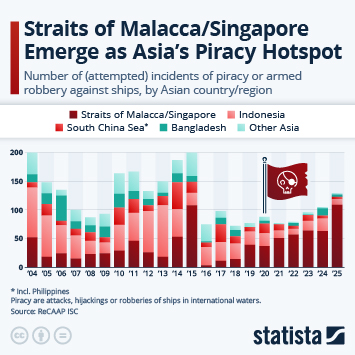
The researchers estimate these disruptions cost the world economy more than $14 billion each year. Piracy and terrorism are also two major driver behind them. Piracy was affecting most goods in the Bab el-Mandeb Strait as well as the Malacca Strait, which recently saw a resurgence of small-scale armed robbery of ships. Terrorism is due to affect most goods in the Bab el-Mandeb Strait as well, where the Houthi rebels are active.
In terms of natural disasters, the Panama Canal, deemed relatively safe in most other regards, is vulnerable to drought, while the Korea Strait and the Taiwan Strait can be affected by typhoons. An accidental blockage, like affected the Suez Canal in 2021, is rated as detrimental at the Panama Canal and even more so in the Bosporus, which as the busiest waterway in the world has seen many accidents and has been called "a disaster waiting to happen".