Six months before millions of football fans are expected to travel to the United States to follow the FIFA World Cup, which kicks off in June 2026, the U.S. Customs and Border Protection agency published a proposal which would make it a lot harder for a lot of people to enter the country. In a notice published on Tuesday, the agency laid out plans to require tourists coming to the U.S. from one of 42 visa-exempt countries, including most of Europe, Japan and South Korea, to reveal a large amount of personal data prior to their arrival. The new mandatory disclosures would include any telephone numbers used in the last five years, email addresses used in the last ten years, family member names, addresses and telephone numbers as well as the last five years of social media activities.
The mandatory disclosure of social media activities in particular drew heavy criticism, not least from human rights groups, who argue that such requirements violate fundamental freedom rights, including the right of free expression. “Requiring temporary visitors here for a vacation or business to surrender five years of their social media to the U.S. will send the message that the American commitment to free speech is pretense, not practice. This is not the behavior of a country confident in its freedoms,” the Foundation for Individual Rights and Expression, a free speech advocacy group, said in a statement.
The Trump administration’s efforts to keep out anyone who “bears hostile attitudes toward its citizens, culture, government, institutions, or founding principles” as the White House described it in an executive order on Inauguration Day, are already deterring travelers from all over the world, whether it’s through outright travel bans, visa denials or the fear of being arbitrarily turned back at immigration. The new social media requirements could put off even more people, especially those critical of the current U.S. leadership.
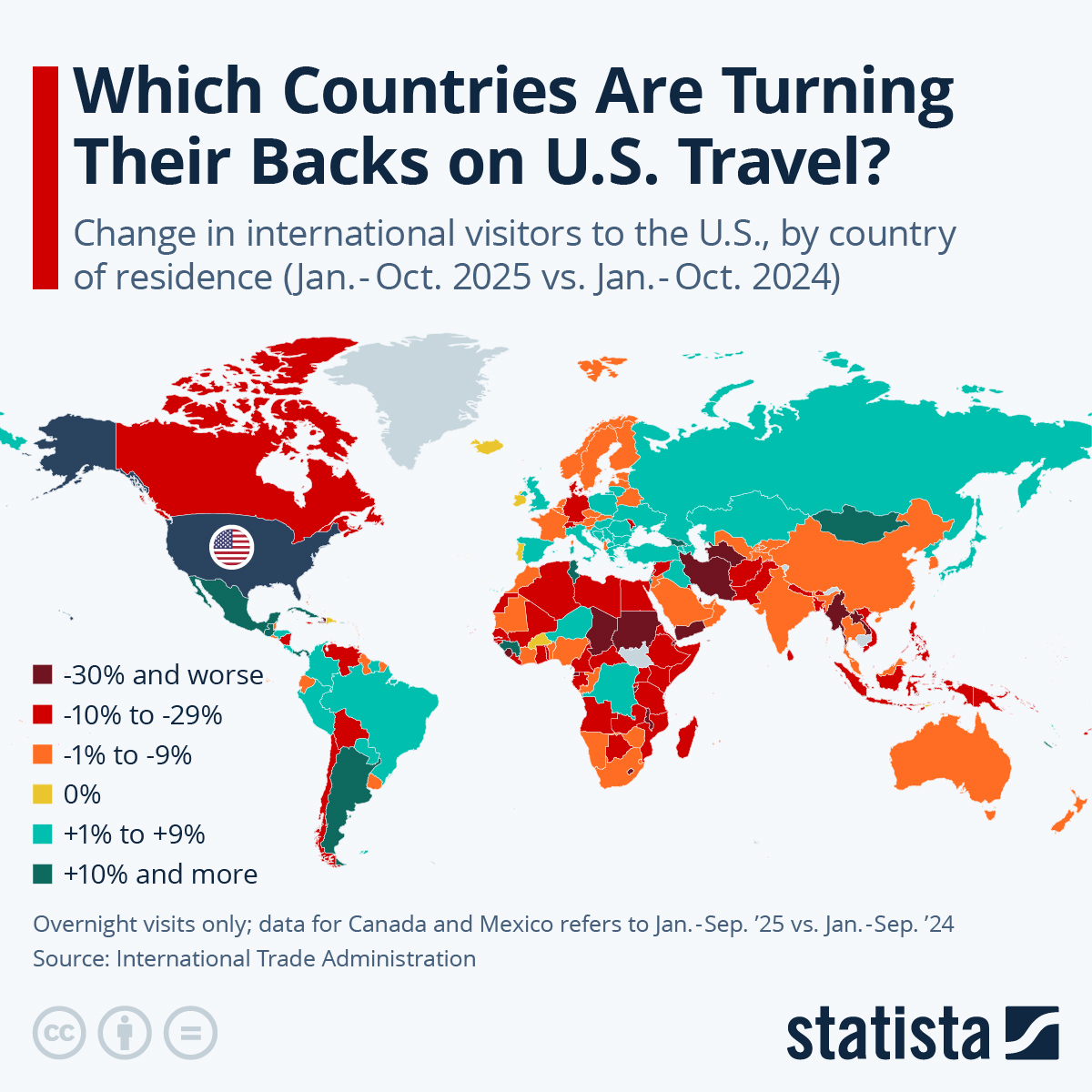
According to arrival data published by the International Trade Administration, the number of international overnight visitors to the United States dropped by more than 5 percent from January to September 2025 compared to the same period a year ago. More than 90 countries saw a double-digit decline in the number of visitors to the U.S., as Canada, Germany, France and India saw the biggest absolute drop in visitors. The number of visitors from Canada alone dropped by almost 3.5 million, with dramatic consequences for U.S. businesses, especially in states bordering Canada. In terms of relative decline, the countries affected by Trump’s new travel ban are unsurprisingly near the top of the list. Countries like Laos, Myanmar, Iran and Sudan saw the number of visitors to the U.S. drop by more 50 to 70 percent compared to 2024. However, many travelers from Western Europe have also turned their backs on the U.S., albeit for different reasons.