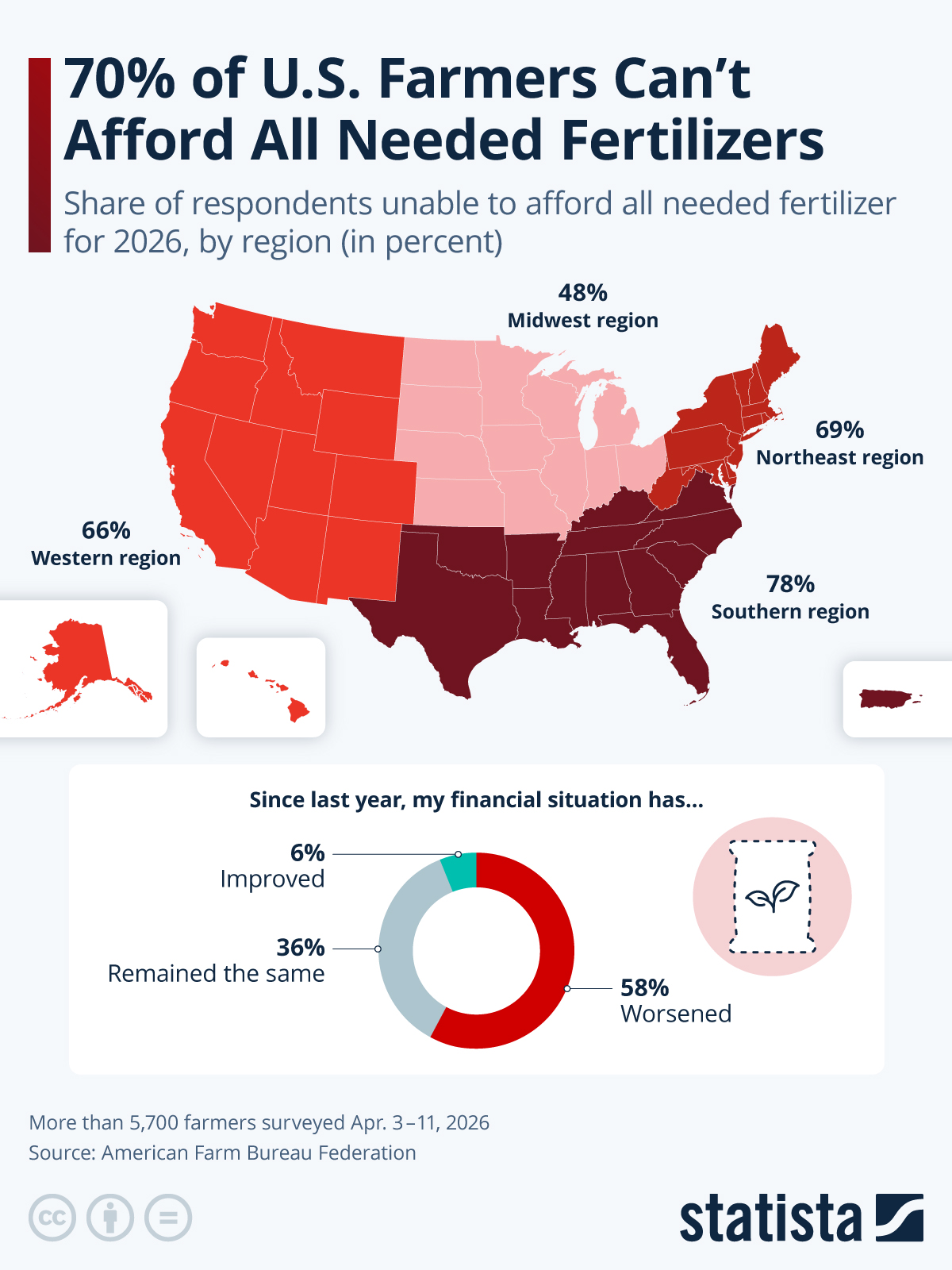
Seven in ten farmers in the United States say they cannot afford all the fertilizer they will need for the 2026 growing season as rising fuel and fertilizer costs linked to the war in Iran continue to pressure farm finances. The findings come from a survey of more than 5,700 farmers conducted by the American Farm Bureau Federation (AFBF) between April 3 and 11.
The financial strain is most severe in the southern region of the United States, where 78 percent of producers reported being unable to afford required fertilizer applications. Farmers in the northeast and west also reported major difficulties, at 69 percent and 66 percent, respectively. By comparison, 48 percent of farmers in the midwest said they could not afford all necessary fertilizer inputs. Analysts warn that farmers who cut fertilizer use to manage costs could face lower crop yields in 2026.
The survey also found sharp regional differences in fertilizer pre-orders. Only 19 percent of southern farmers said they had purchased fertilizer ahead of the season, compared with 30 percent in the northeast, 31 percent in the west and 67 percent in the midwest. According to the AFBF, smaller farms reported lower pre-booking rates, leaving them more exposed to recent price volatility.
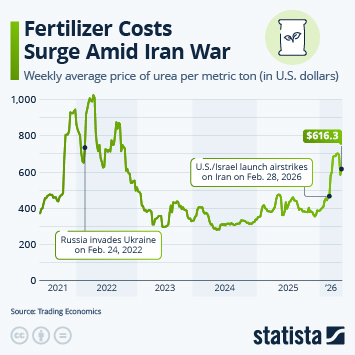
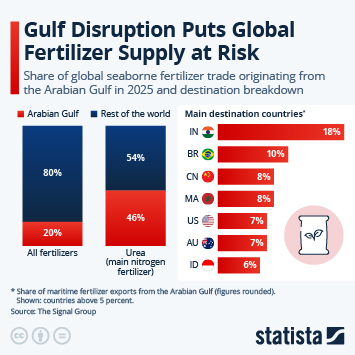
More broadly speaking, 94 percent of farmers said their financial situation had either worsened or remained unchanged over the past year, while just 6 percent reported improvements. This is partly volatile fertilizer and fuel prices, driven in part by disruptions linked to the Strait of Hormuz blockade.